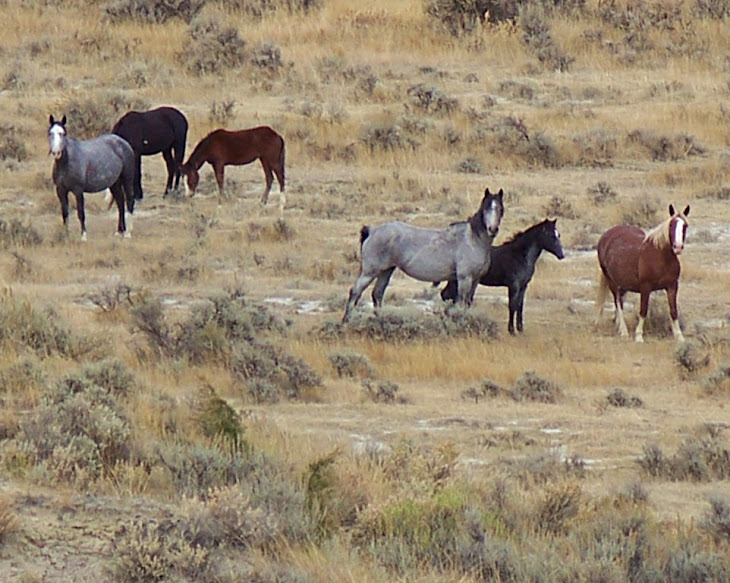
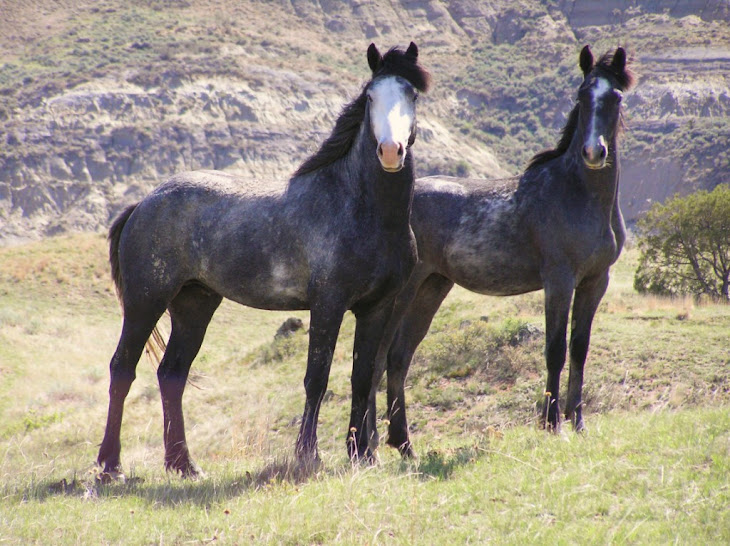
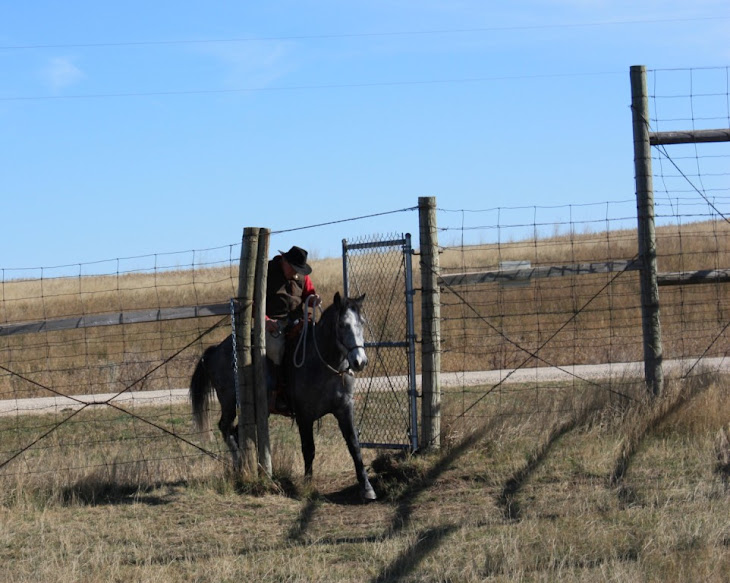
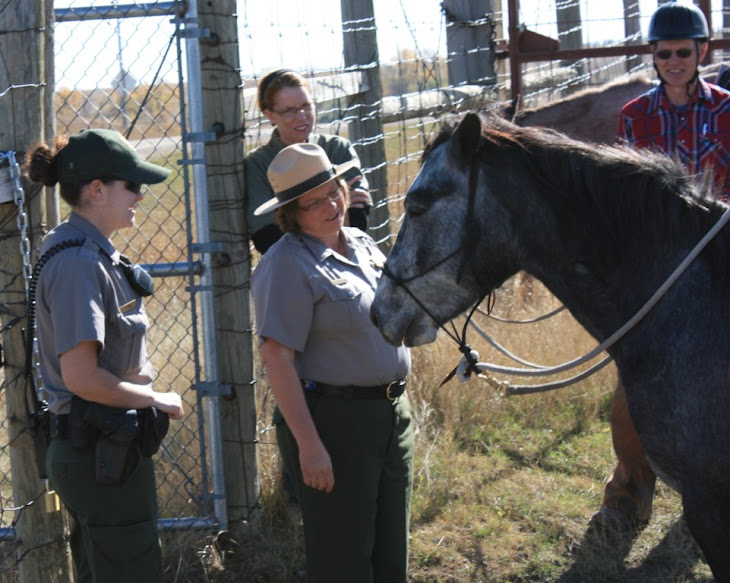
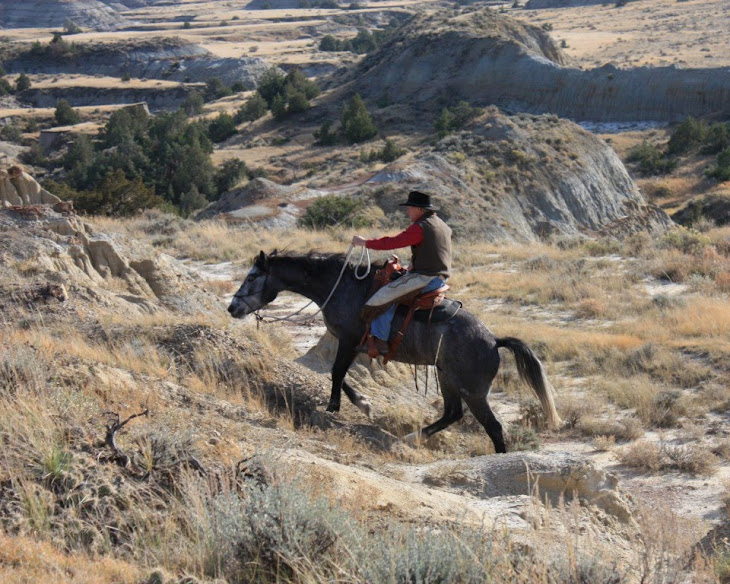
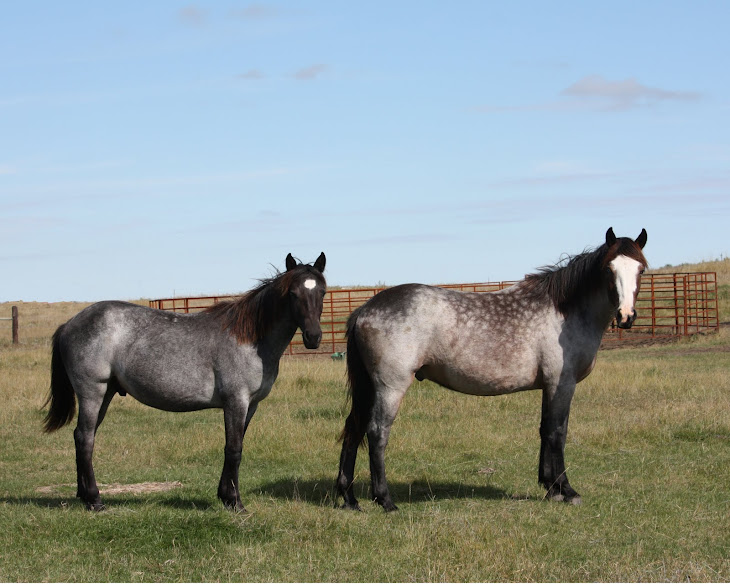
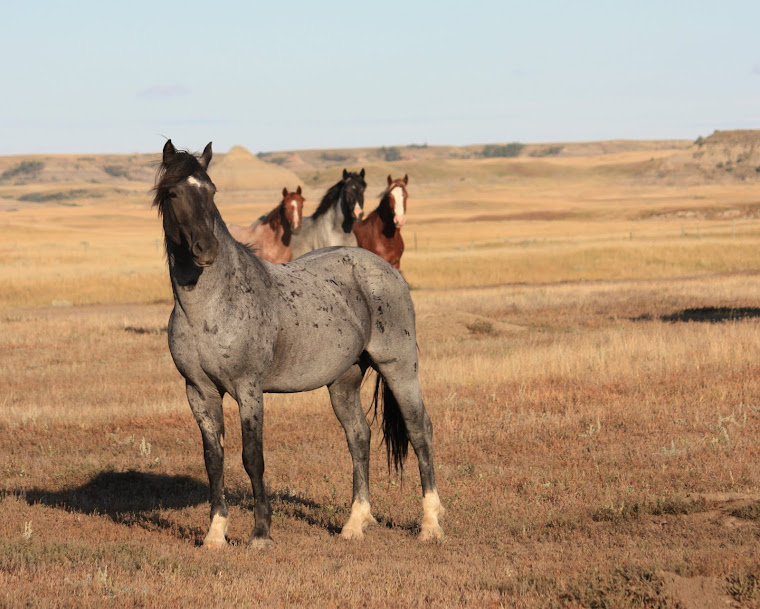
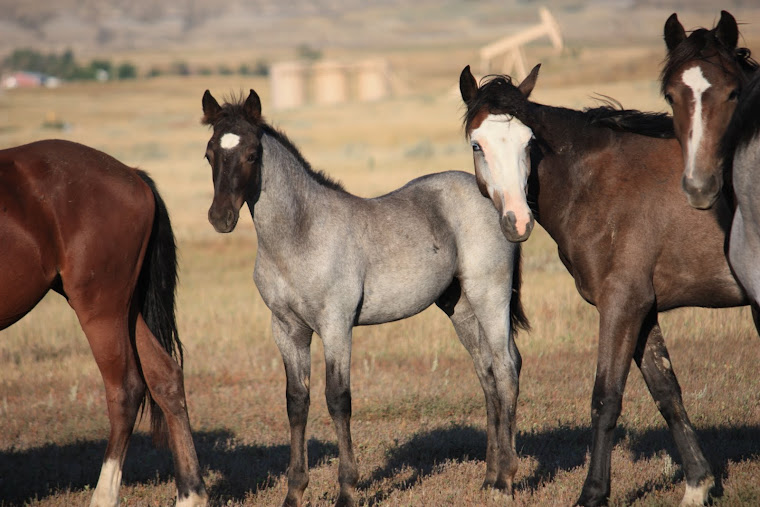
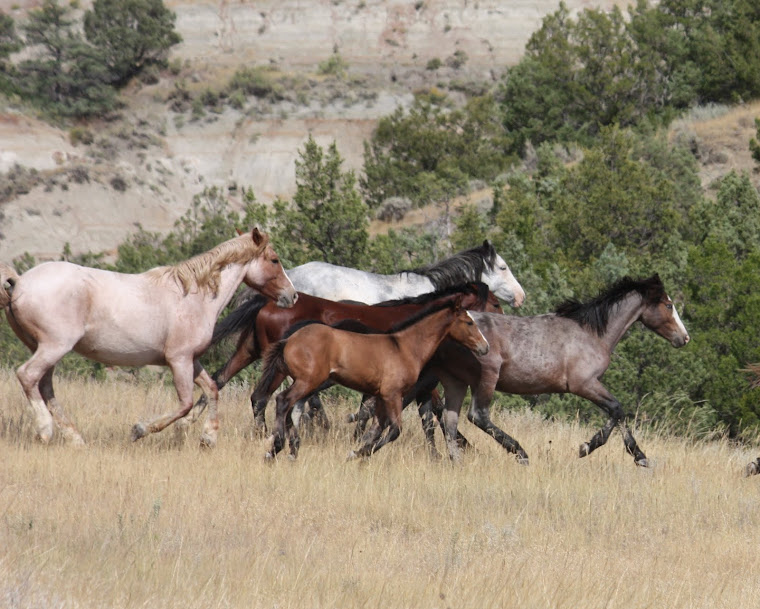
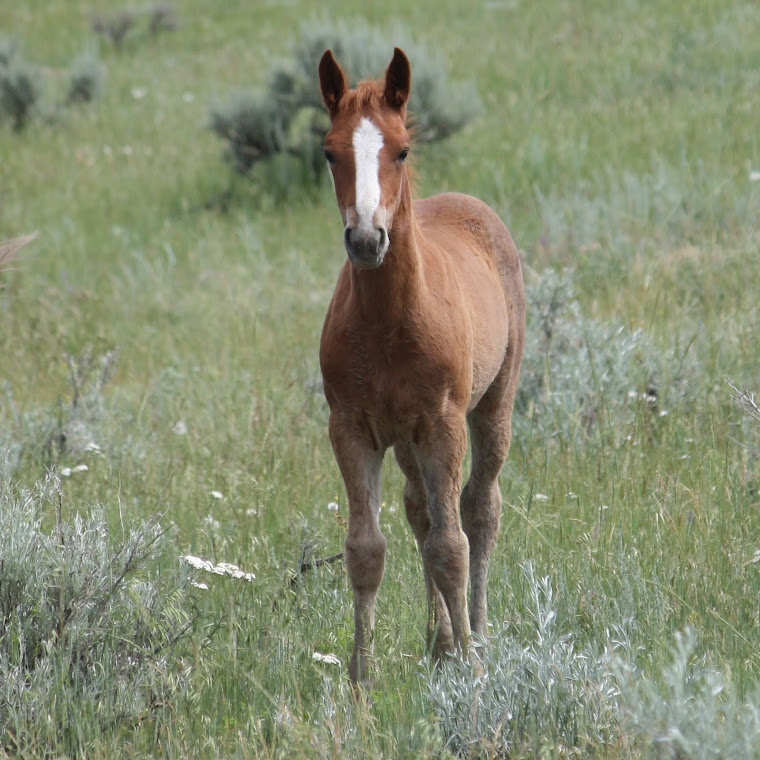
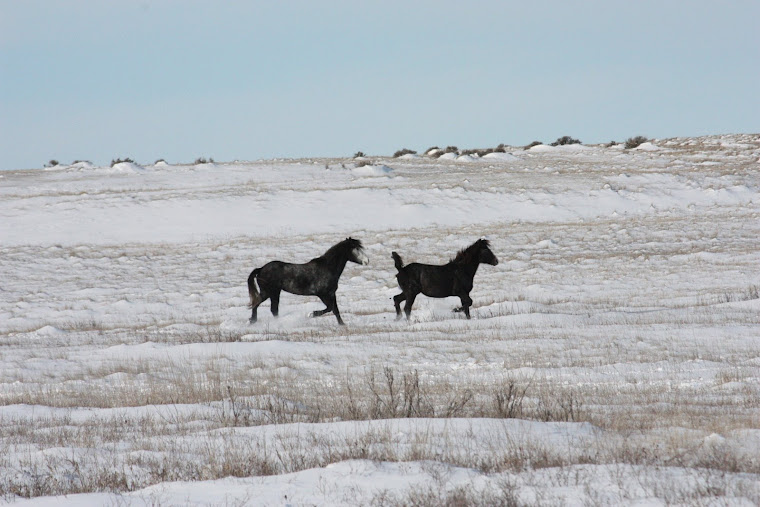
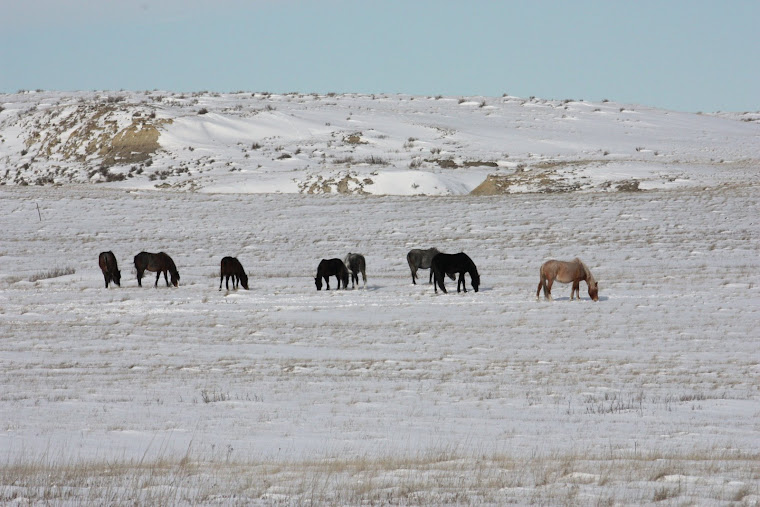
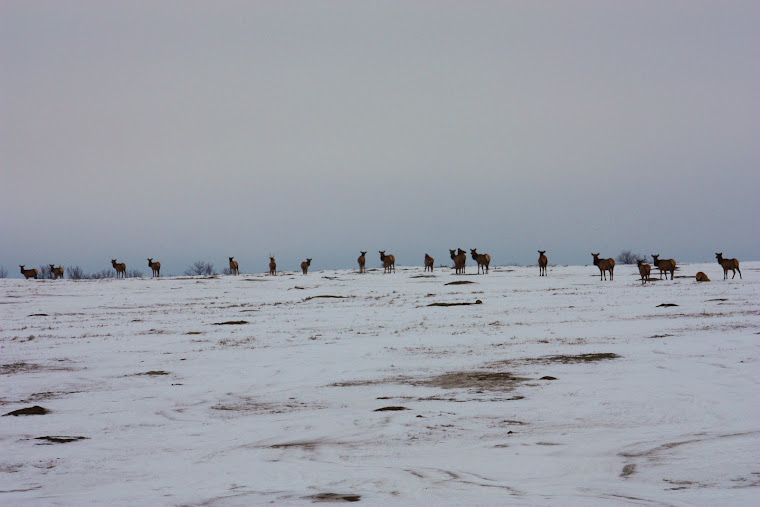
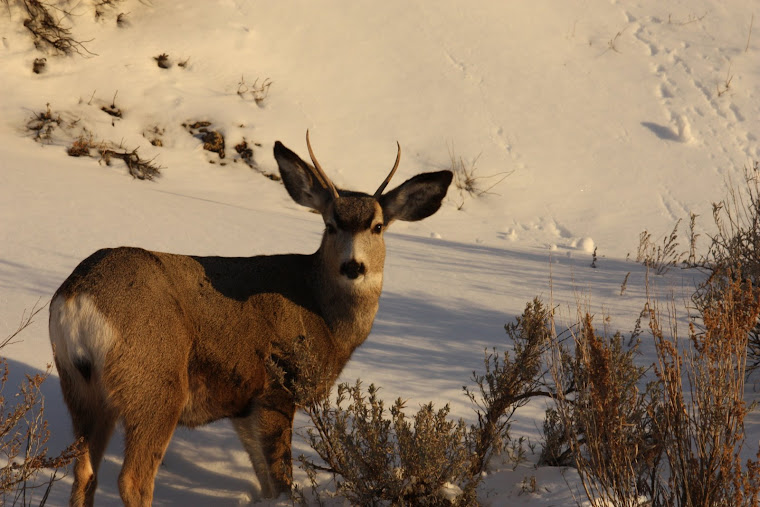
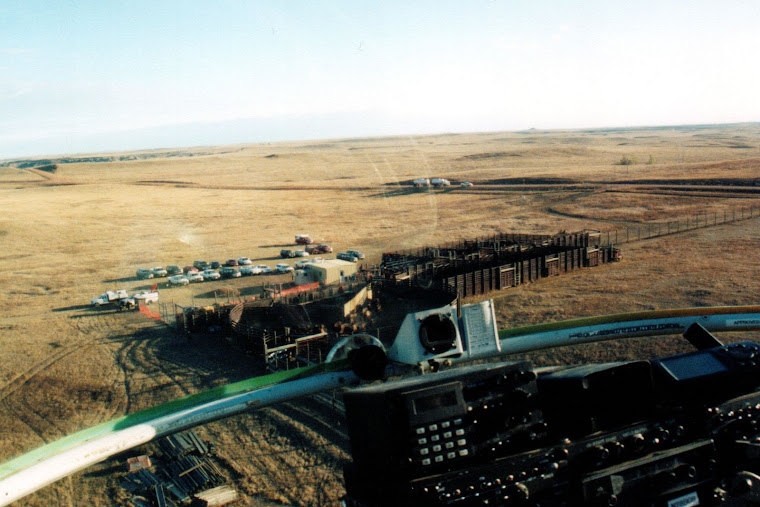
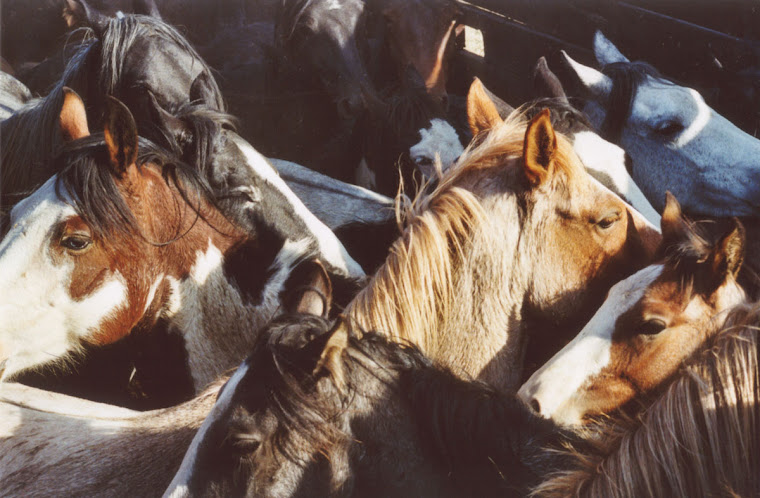
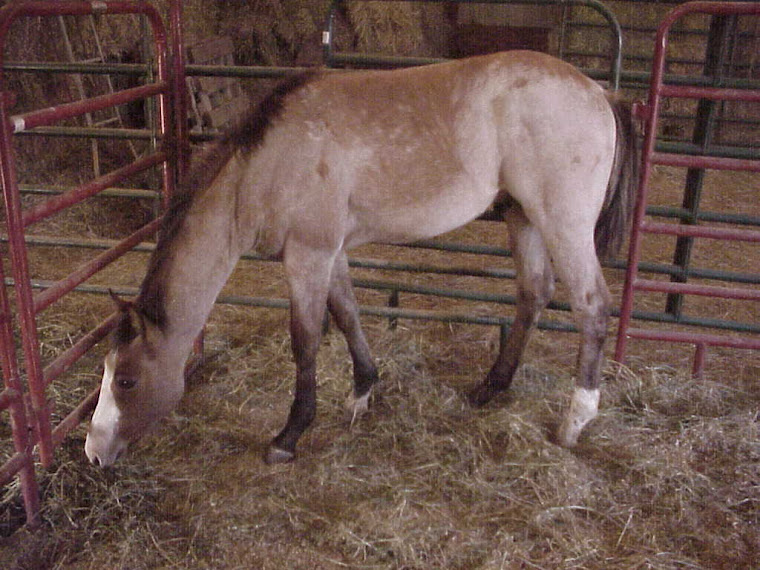
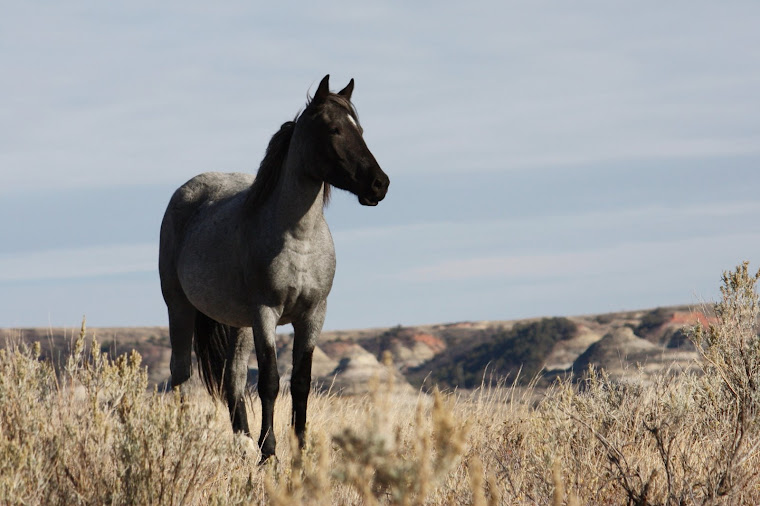
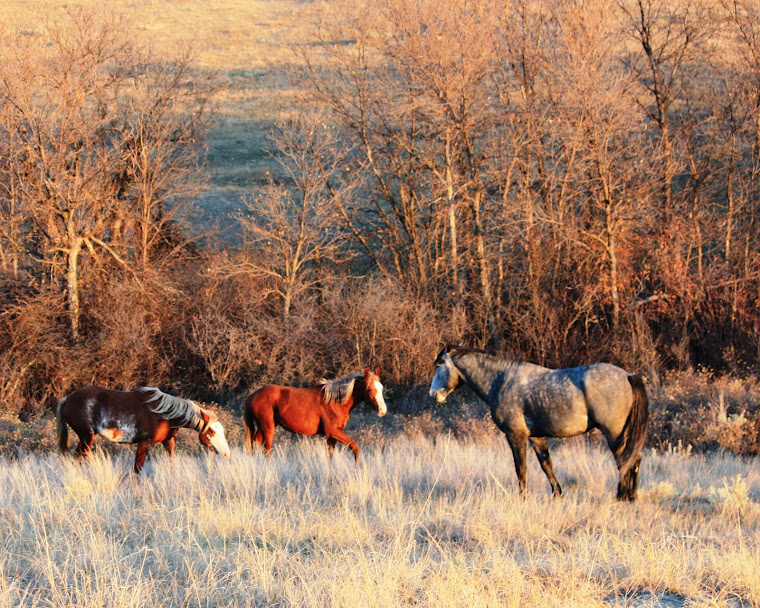
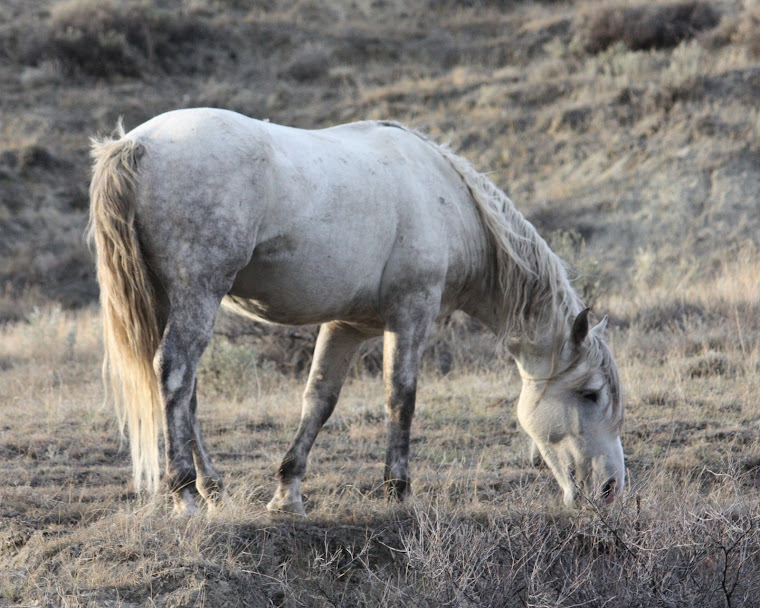
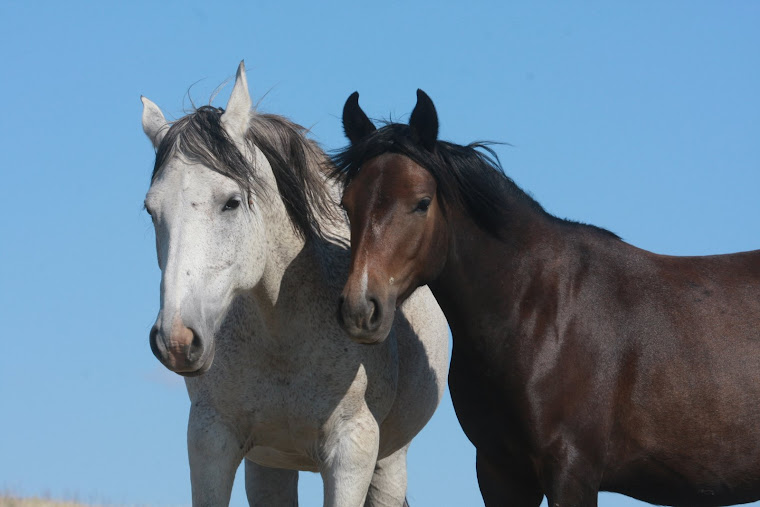
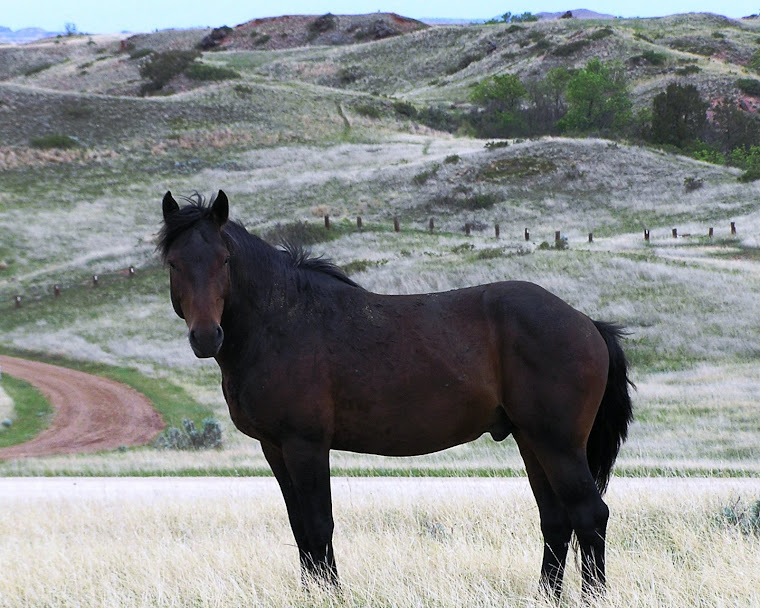
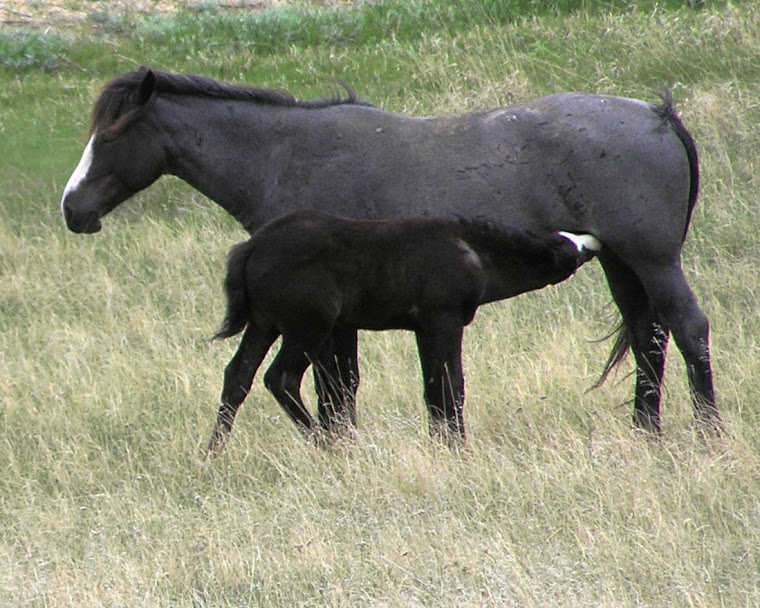
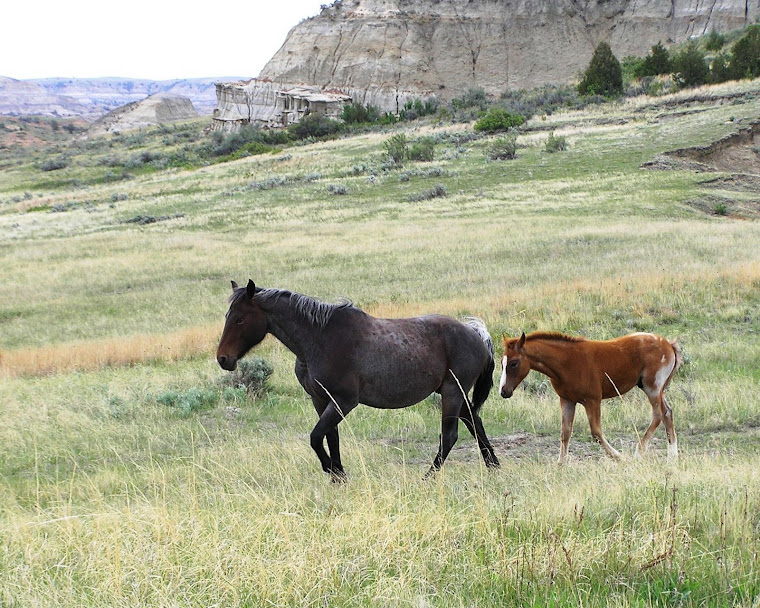
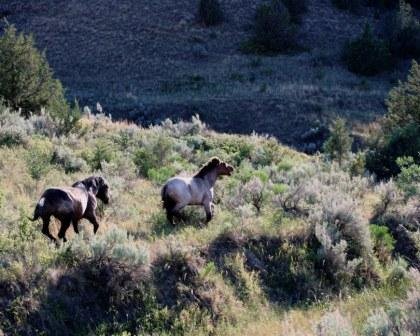
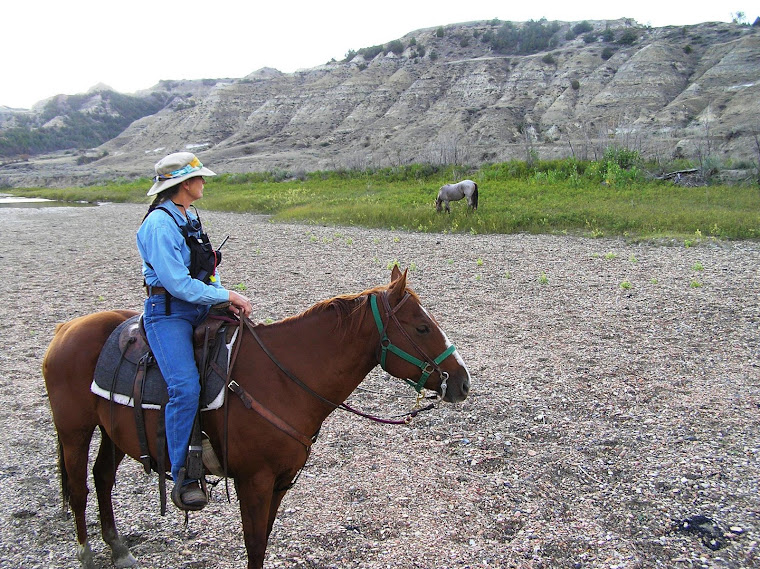
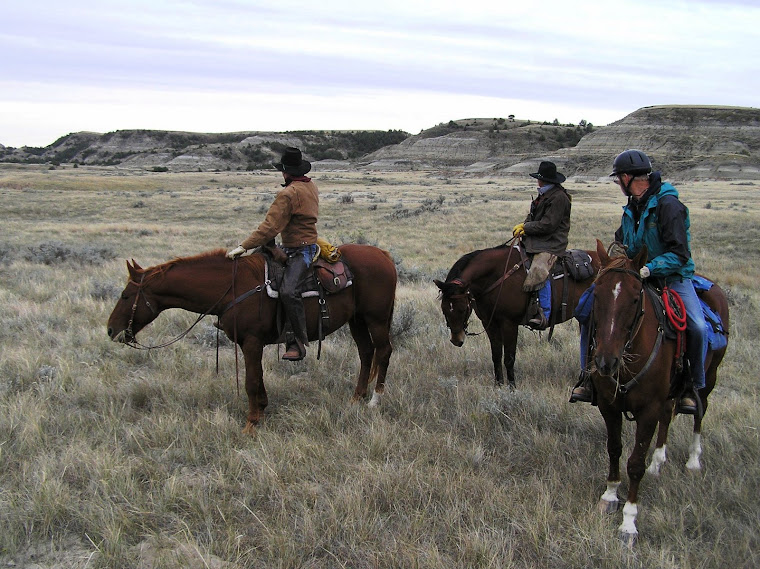
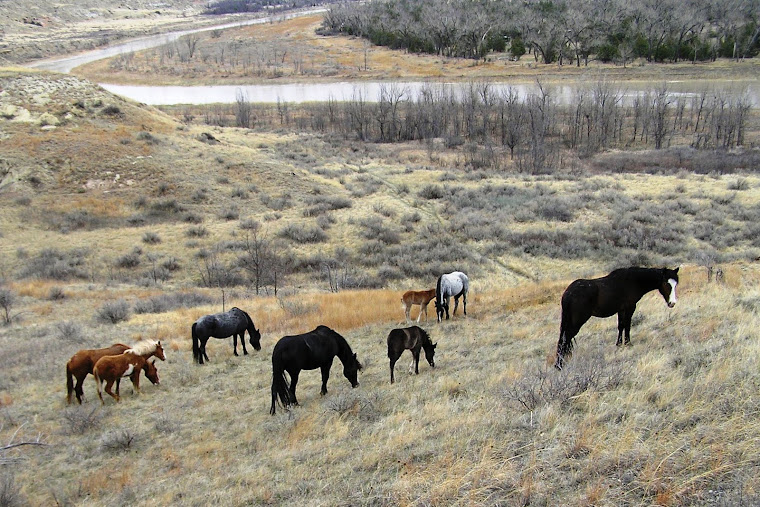
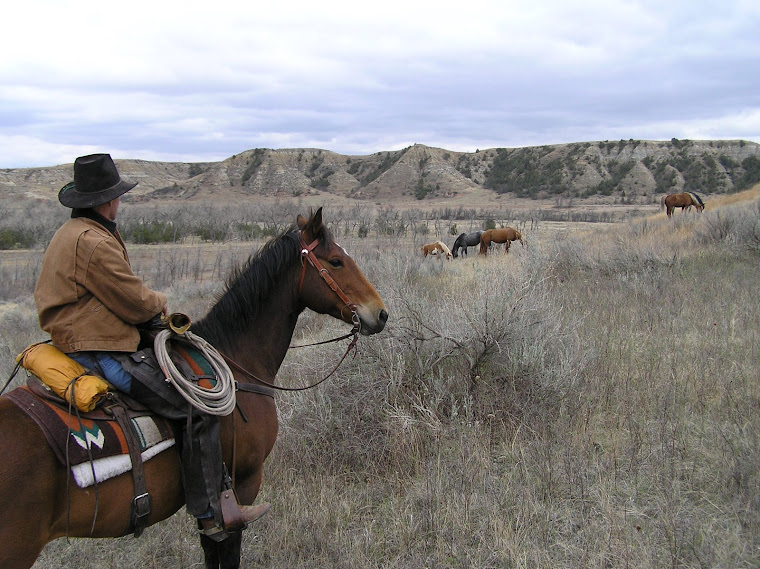
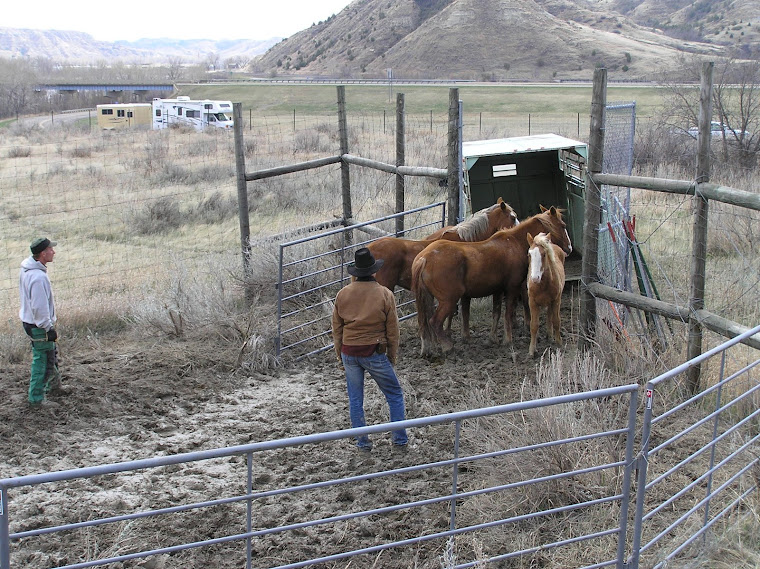
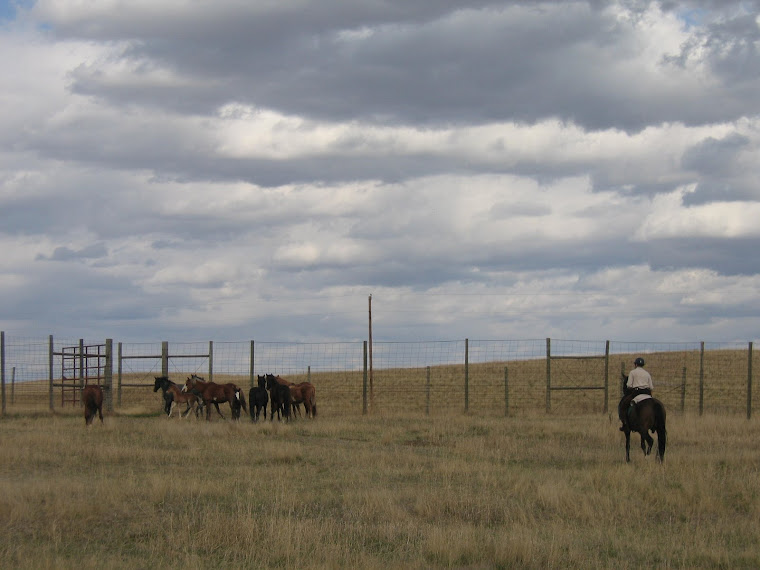
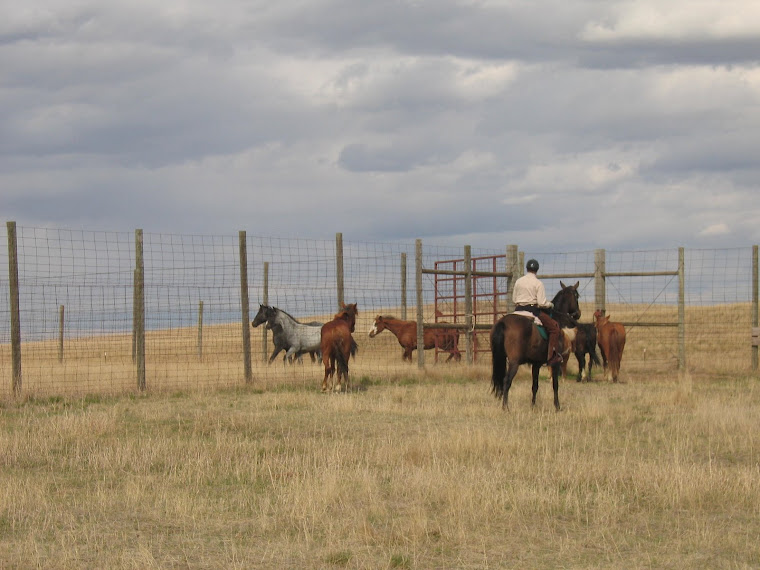
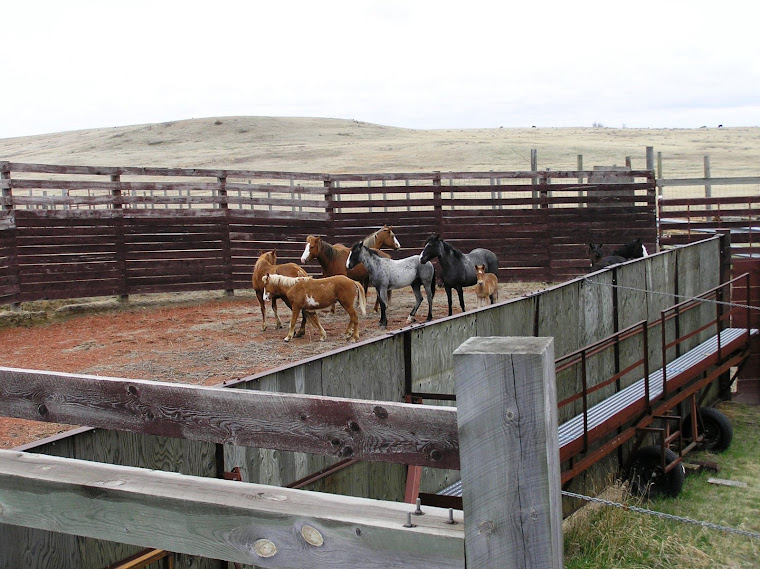
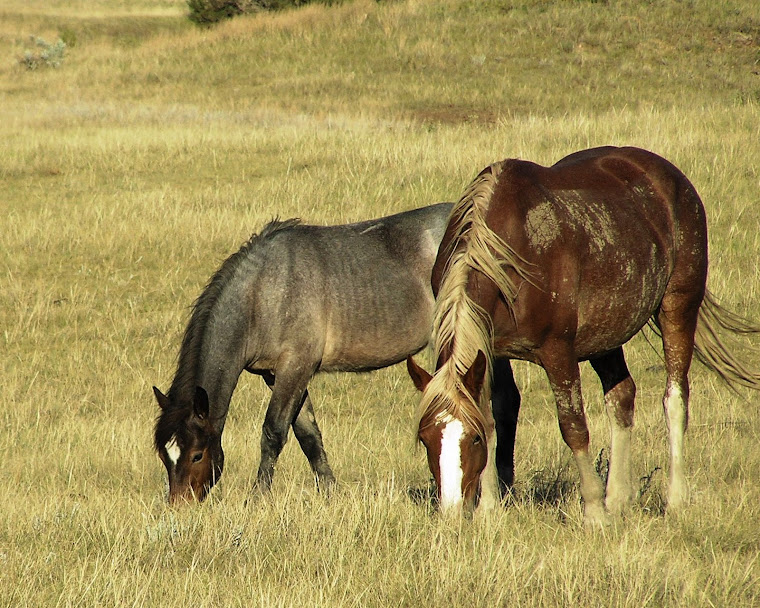
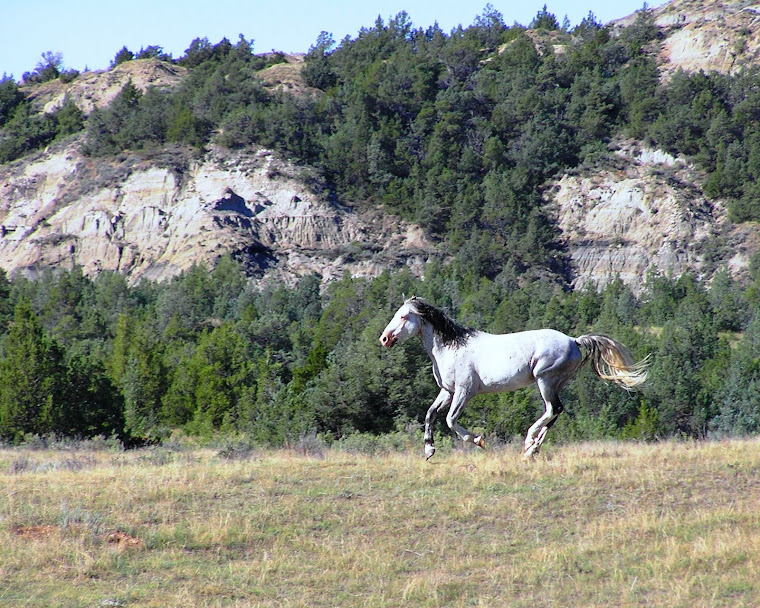
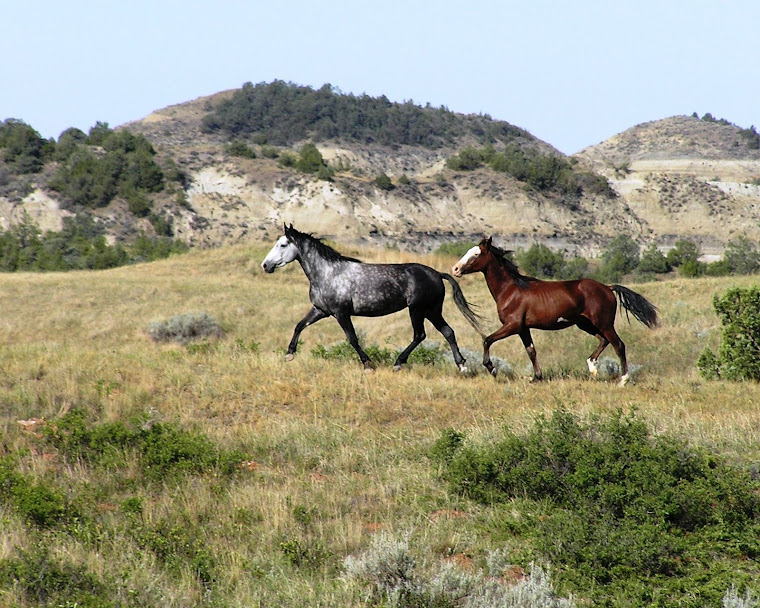
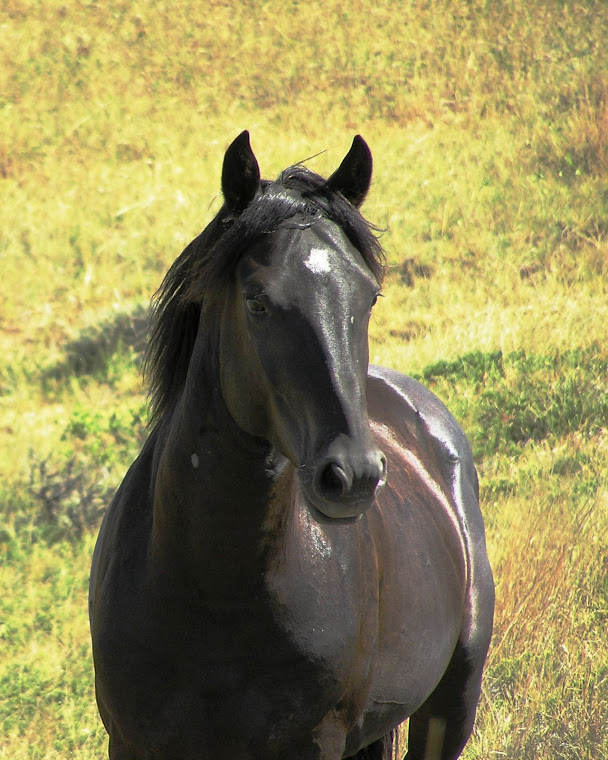
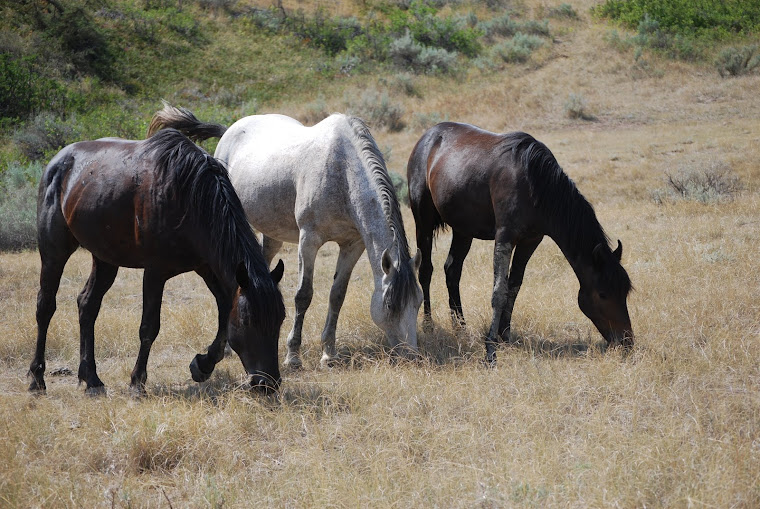
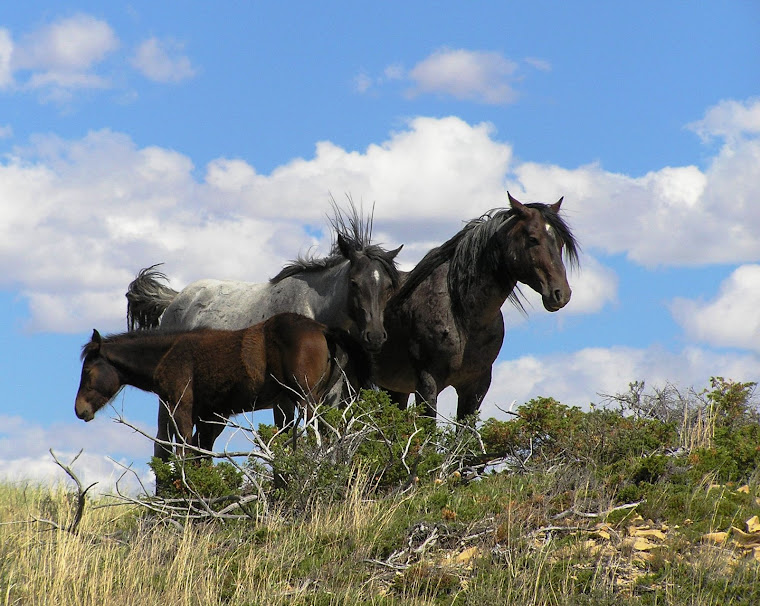
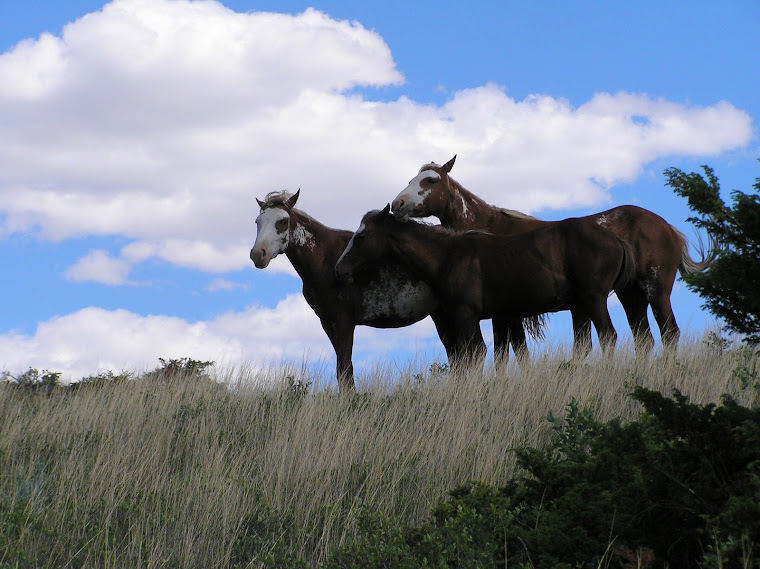
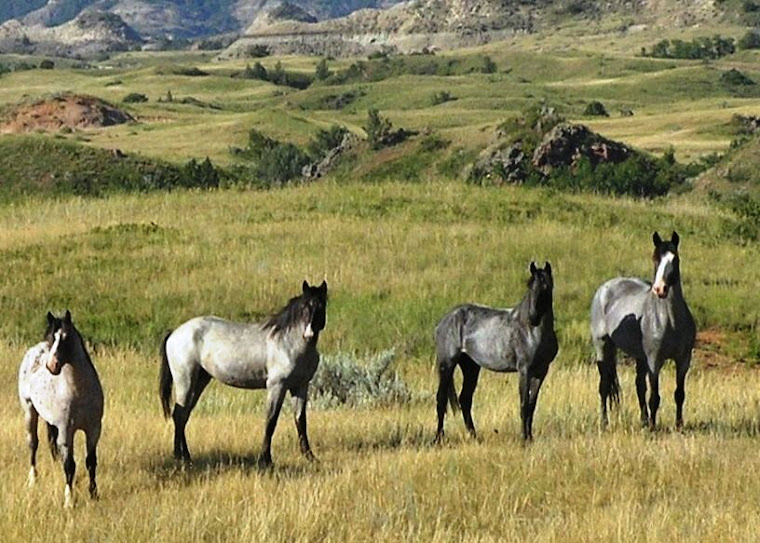
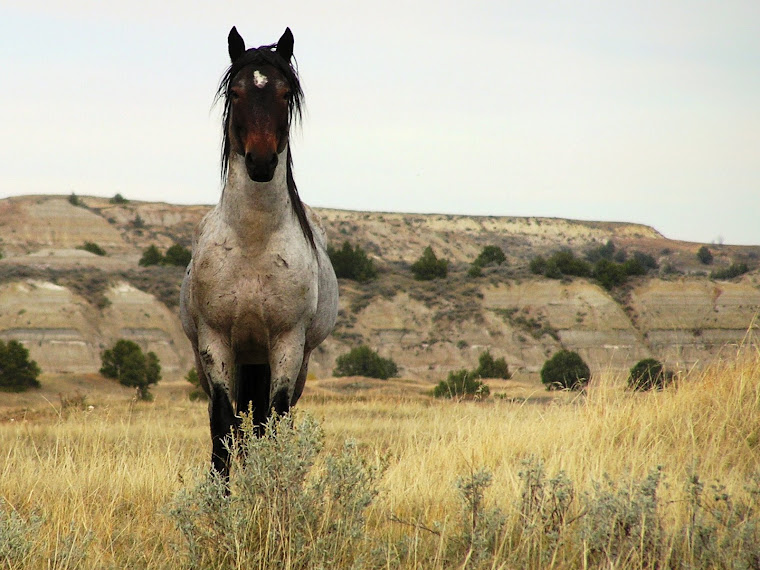
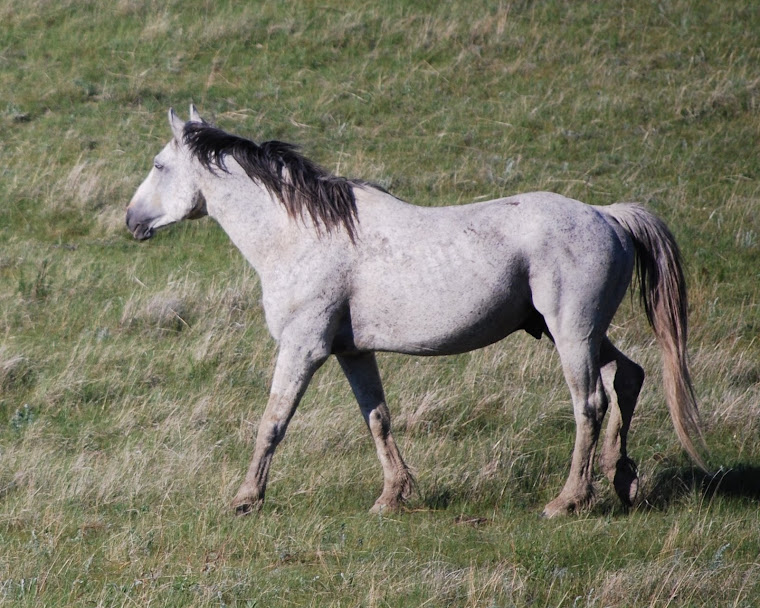
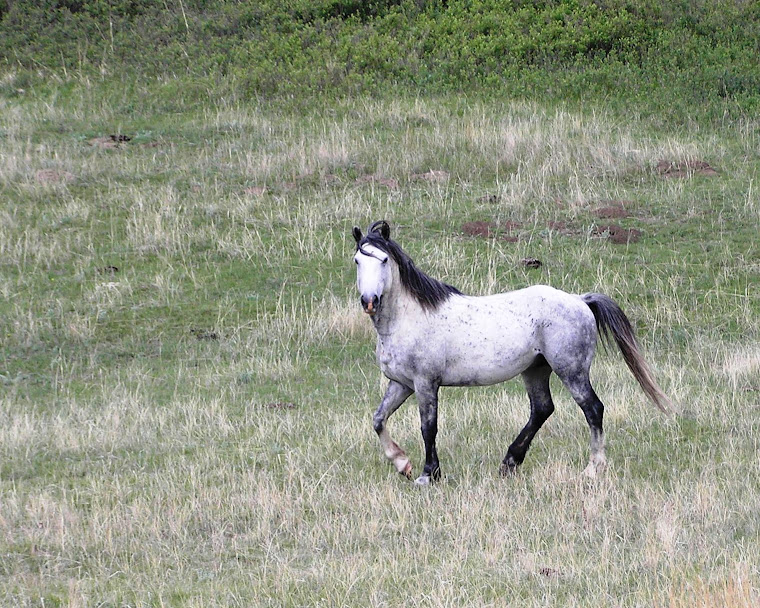
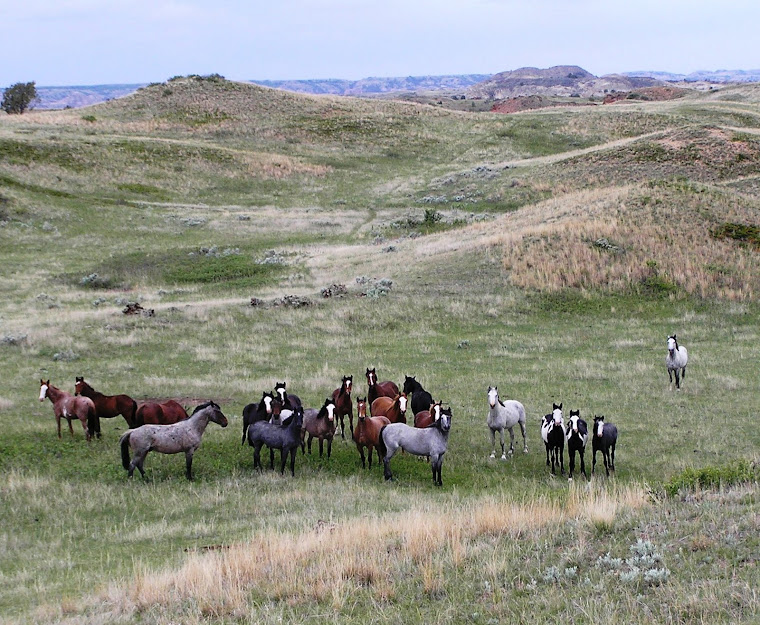
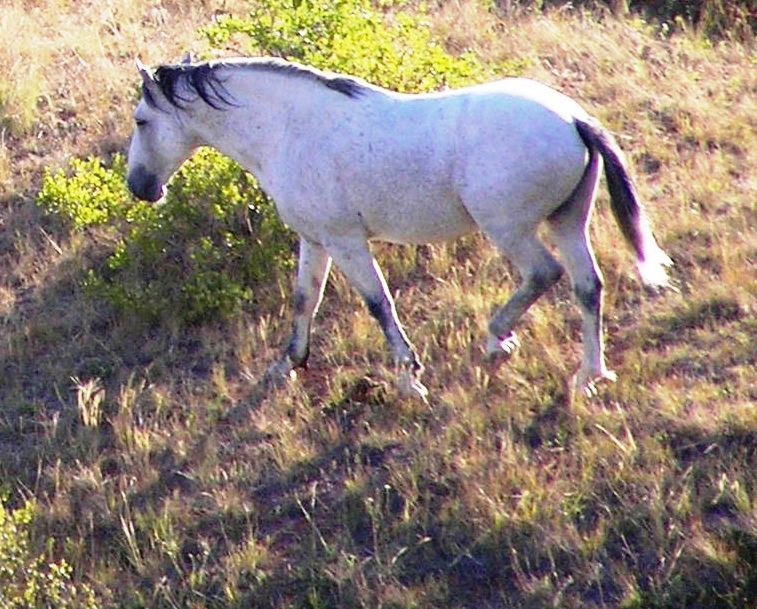
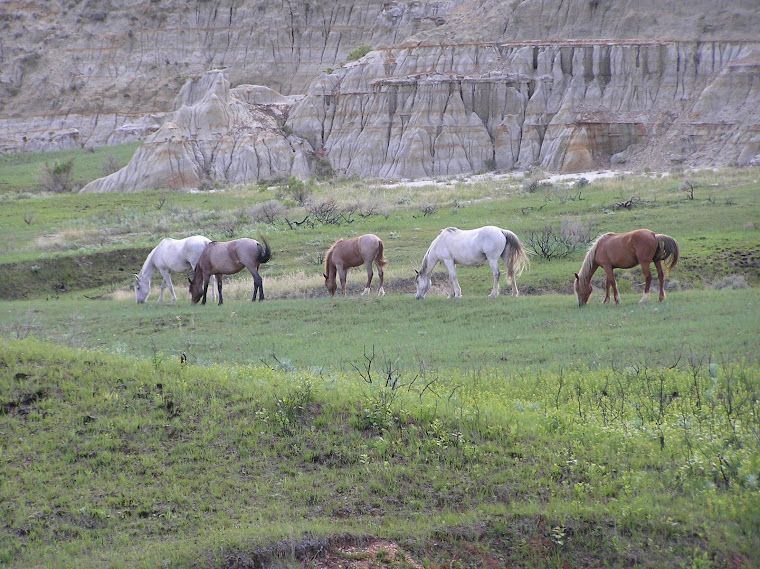
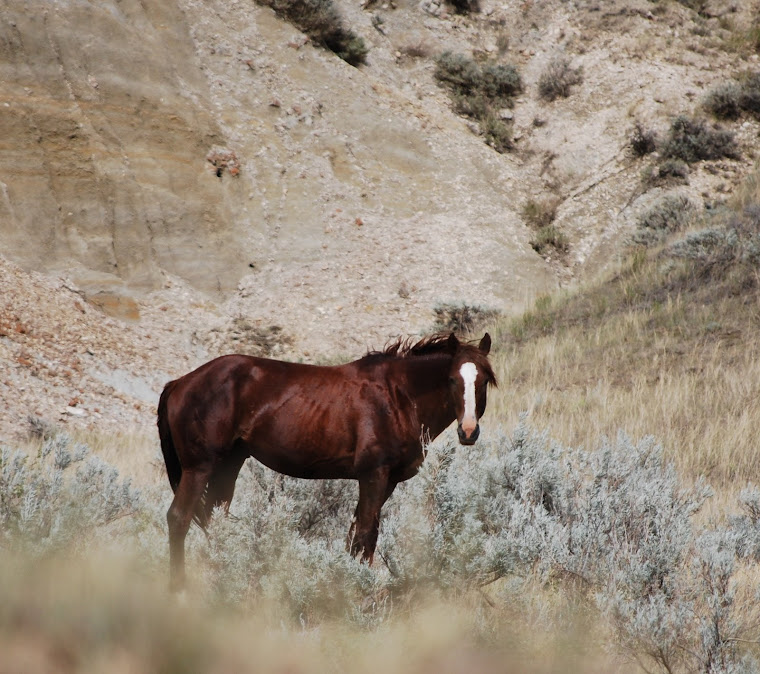
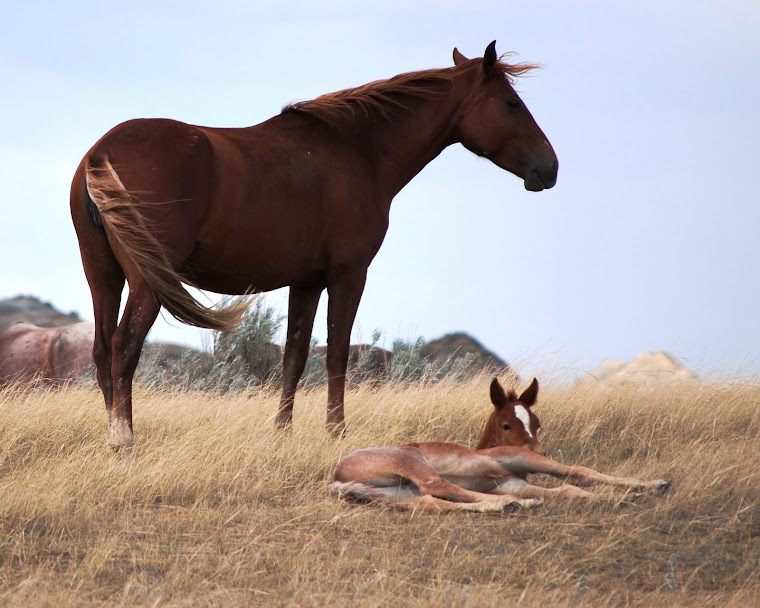
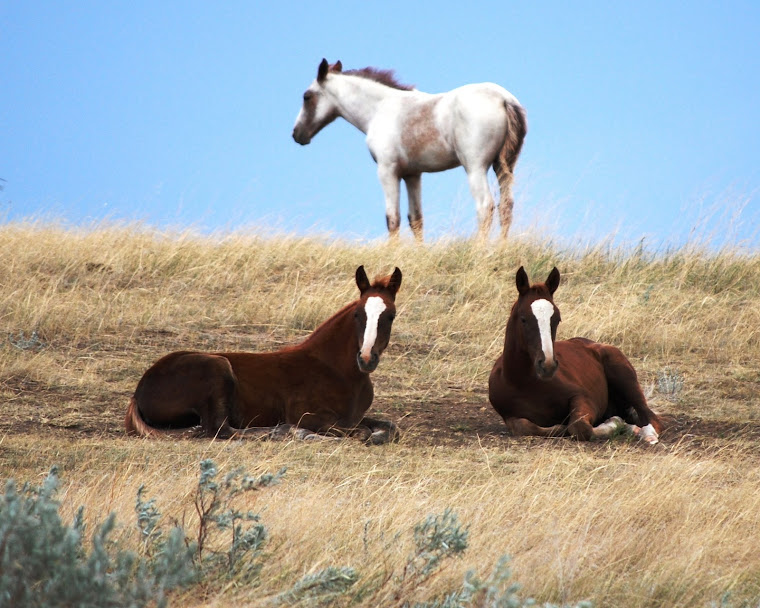
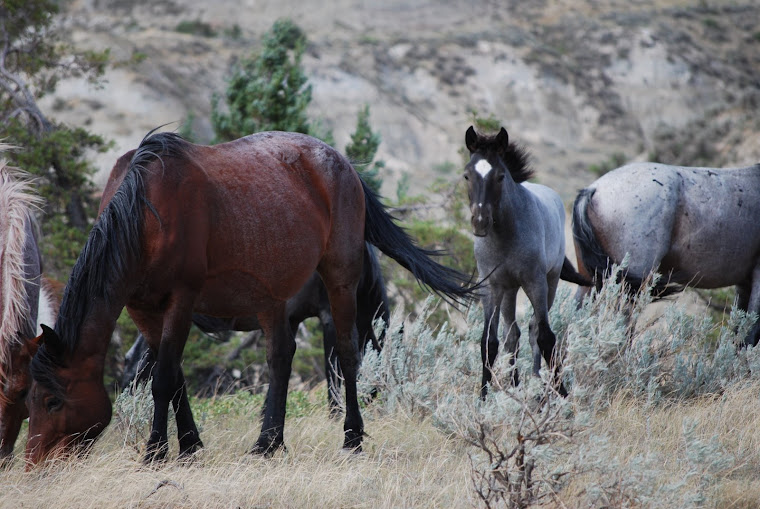
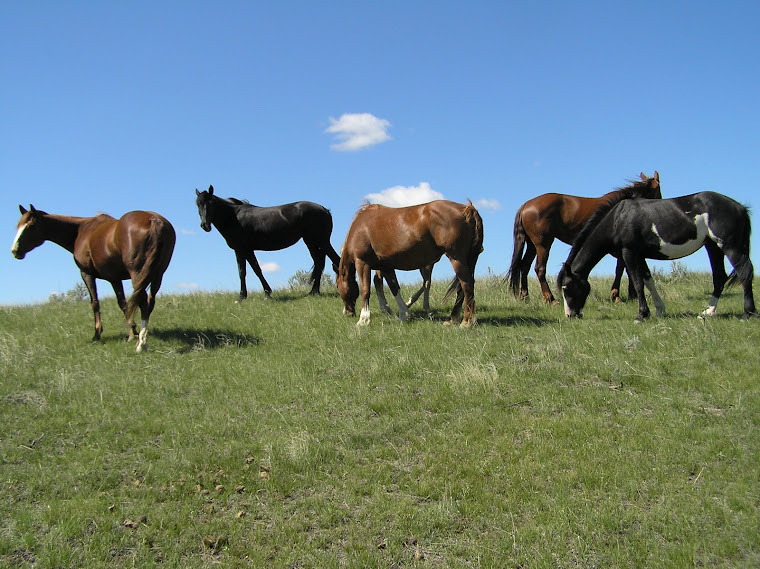
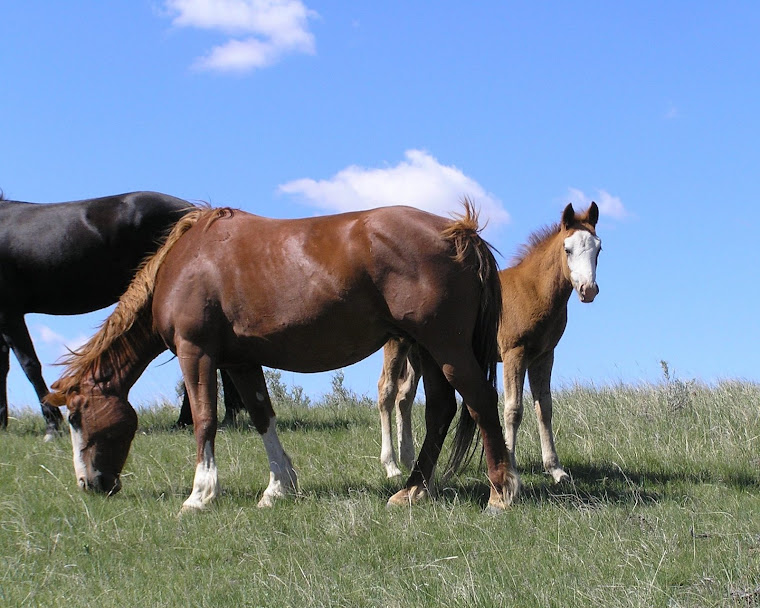
During the spring and summer of 2009 there have been 31 foals born in the Park that have survived. Over the past six years, new foal crops have brought the total number of horses to about 164. Since the horses are designated as a demonstration herd to represent the wild bands that Theodore Roosevelt saw and wrote about when he lived in North Dakota, they too are kept from multiplying themselves out of a home. Bison, elk, dear, and pronghorn all share the vegetation in the Park and there are few natural predators for the larger species, so there has to be periodic reductions of the larger animals in order to keep a balance of species and not overgraze the Park Though Park personnel are dedicated to finding better methods of keeping the number of horses under control in the future, it is necessary to round them up this fall and sell off a number of individuals.
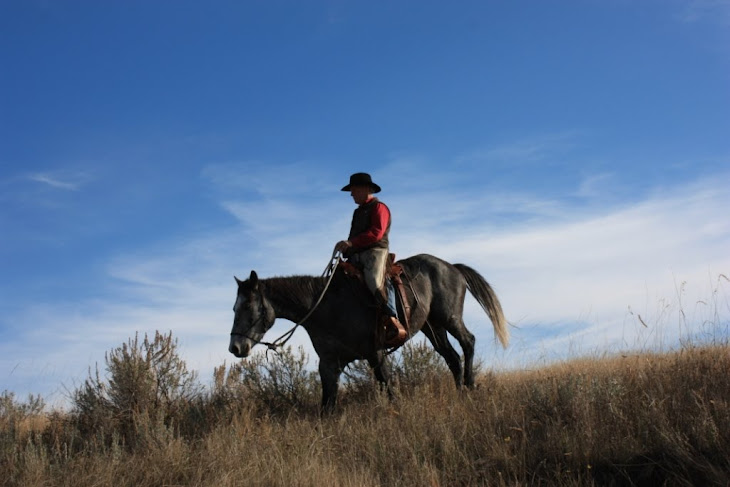
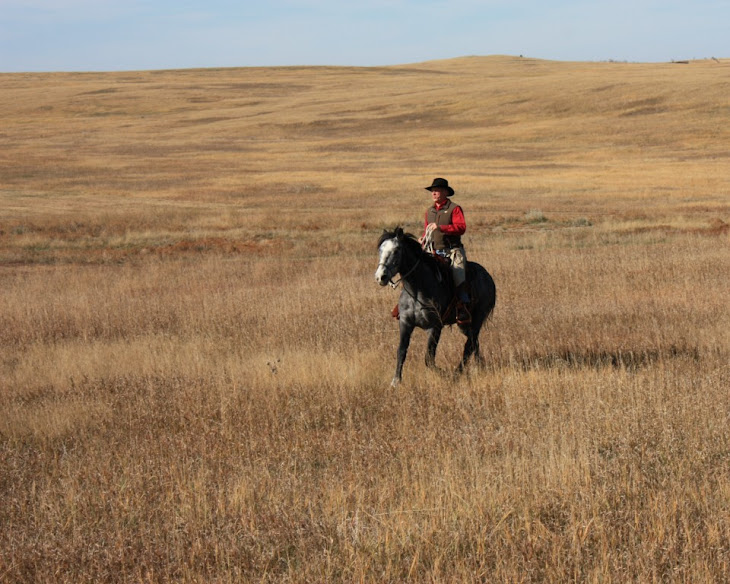
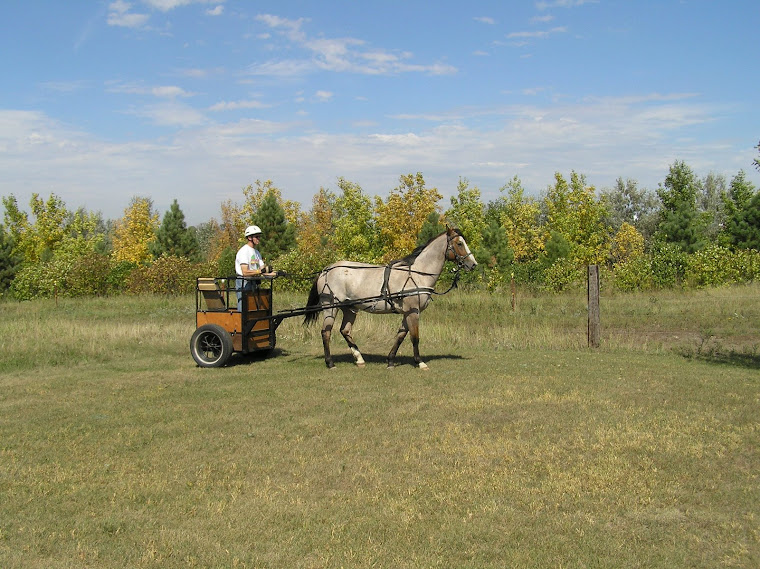
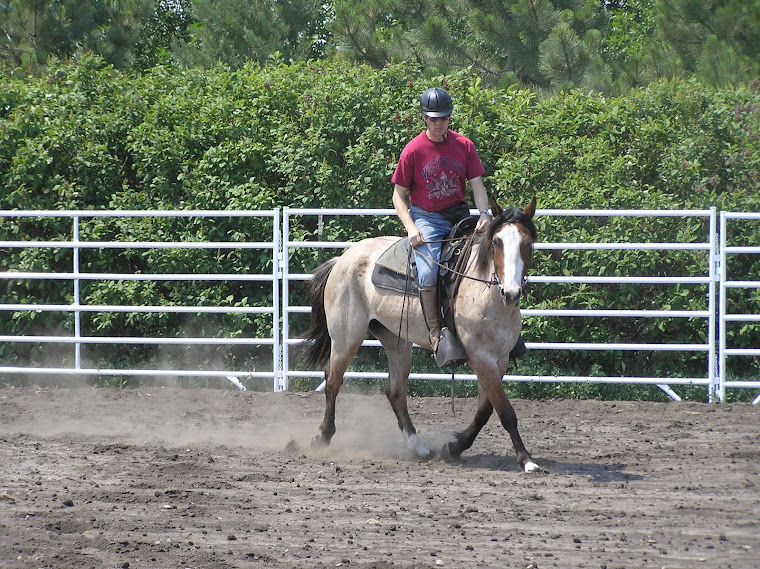
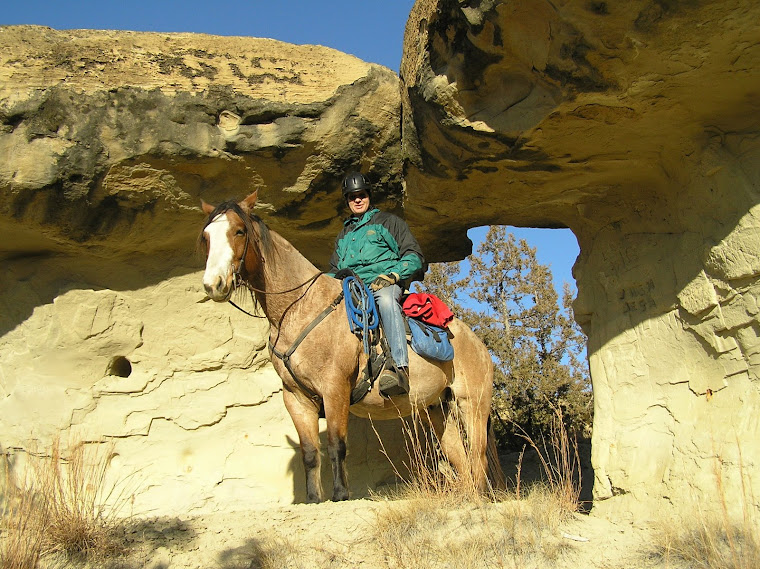
These horses have proven themselves to be great using horses for a great number of purposes. They are being used as ranch horses, driving horses, dressage and jumping horses, as well as just good family trail horses. Our experience has been that they are easy to gentle and train and that they like to be around people. They are sturdy, sure footed, strong, and tend to stay sound because of their long history of survival. Weak animals die off and do not reproduce, so those who make it are tough, with strong feet and legs.
In hope that every individual will find a home after the sale, most of the culled horses are going to be young. There will be horses of various colors and all ages from weanlings and yearlings to a few older studs that can still be started by skilled trainers. The horses will be sold at Stockmen's Livestock Exchange on the east side of Dickinson, North Dakota on October 23, 2009.
I will be featuring some of the horses in this blog over the next several weeks and months, but for those who are interested in buying a horse, I can tell you how to get the entire file by age at PhotoBucket. That is the best I can do until I firgure out how to get a link to them.
If you have experience with young, unbroken horses and have the facilities to keep a wild horse safe until it is gentled, then think about giving one of these special horses a home. There are also individuals who are willing to gentle a youngster for someone who is unable to do it himself.
Contact me at horsetracks@btinet.net for more information.
Sunday, August 9, 2009


Thursday, August 6, 2009
HAZARDS, DID I MENTION HAZARDS
THURSDAY, AUGUST
6, 2009
This spring and summer, with the wild horse behavior study, has
been a learning experience in more than just learning more about the horses. We
have learned that one must be aware of what is brewing on the other side of the
butte.
In June, Henry and I had hiked to the flats where the Boicourts had built their farm. We were sitting among the remnants of a foundation, recording the behavior of the double band of Red Face and Singlefoot. Earlier, we had noticed a line of dark clouds forming behind the Boicourt Ridge behind us, but we felt lucky that the storm had blown past us to the south. We were about half way through the 20 minute study when we felt a few raindrops. Maybe we could hold out for the rest of the 10 minutes.........................maybe not. With no warning, it started to hail. We started running for cover like two old western cowboys dodging bullets. The hail was stinging the backs of our legs and any exposed skin. We were running for some kind of shelter from the hail and the lightning. The nearest gully would have to do, so I dashed into the first gully off the nearby ravine. It was full of Poison Ivy! Every inch of soil flourished with the tender, three leafed varmints that were just waiting to spread their venom all over our bodies. We leaped out of the gully and sprinted farther down the side of the ravine until we found a solid clay bank. It was good enough; we clamored over the lip and huddled against the clay for protection. It didn't really provide any protection from the hail, but it put us below the rest of the flat so we weren't puny moving targets for the lightning bolts.
We must have been laying in our fetal position in the clay for at least 20 minutes until the hail finally stopped and the rain let up some. While a light rain continued, the question came to me whether we should make a run for the vehicle a mile away or wait for the sun to come back out and finish the study. Turning over on my now muddy bank, I caught a look at Henry for the first time since our escape from certain death at the Boicourt homestead. His heavy blue jeans now encased in ice, he was shaking uncontrollably, like he had dunked himself in a lake in the middle of January. I guessed he didn't want to wait for the sun, even though I could now see blue sky over Boicourt Ridge. We drug ourselves out of our muddy sanctuary and slogged back to the protection of old Air Force Blue.
The sun did come out and we did dry eventually and complete more studies that day. But, it wasn't to be our last encounter with Mother Nature's wrath.
A few weeks later I was out with a tracking friend. Henry and Hedrick were also going out as a team so that we could get more bands observed. The friend had been in Medora for several weeks and still hadn't been able to track down Blaze to get any good photos of his band. I knew they had been hanging on the flats east of Buck Hill, so we headed for Buck Hill to see if we could spot them. There they were where I expected to find them, about a mile and a half down on the flats. It looked like a nice evening for a hike; it wasn't too hot anymore and the clouds we could see did not look threatening. We parked the truck on Buck Hill and headed for the horses. It was a pleasant walk that only took about 20 minutes and it was still early evening.
Blaze is always a lot of fun to photograph because he is pretty wary, so always gives us a good show. We wanted some photos of Little Brother's Girl's filly, Sheila, and Domino's new colt, Talkington. They were quite cooperative, letting us get close enough for some photos before we sat down to start the study. As we recorded their behavior every minute for 20 minutes, we noticed that the sky was getting darker, but we figured it was worth getting a little wet, to get good photos and a study of the illusive band. About the time we finished, it began to sprinkle.
By this time the clouds were building quickly in all directions, but it looked as if the storm might blow off to the north. I commented on the strange looking, dark clouds over Buck Hill as we looked for some cover to ride out the showers. Nearby was a deep ravine, and having had experience with the protective quality of ravines in the recent past, I decided it was our best bet. We found a flat spot at the bottom of the ravine where the bank rose about 20 feet above our heads and there was a nice spreading cottonwood that barely reached above the bank. We settled in for what we hoped to be a safe reprieve from a short squall.
Dressed only in light clothing, we were the most concerned with keeping out cameras dry. We laughed about getting caught in a storm AGAIN as the rain fell. I was concerned that Henry might be looking for us, but my phone had no service and I didn't think he had a Park radio, but it was worth a try, so I turned it on. We could hear the conversations of local law enforcement monitoring the storm. We heard someone say that a tornado was spotted just south of Medora heading..........................sssssssssssssssscccccccccckkkkkkkkkkkkkk. Static, nothing but static. Again we heard someone say something about having checked out the problem at Painted Canyon, but we didn't know what the problem might be. She asked, "Where is Painted Canyon from here?" We were about a half mile from Painted Canyon! We were still hoping that most of the storm would go around us when we heard the report that the line of severe thunderstorms reached from the South Dakota border to the Canadian border! It was not looking good for the storms to miss us and the radio was not raising any response.
As the rain poured and soaked us to the skin, we began to watch the water rise in the ravine. I said we had to have a plan of where we were going to get out if the water rose too quickly. The clay sides of the ravine were turning to gray slime which would not be easy to climb. Pressing our water logged bodies as close as we could to the tree, we watched the water rise. It seemed that the storm couldn't get much more miserable when I heard a "plunk" on the brim of my hat. Now it was hailing! I was wishing I had had the brains to bring a rain coat when the rain suddenly stopped-this was our chance!
As I had expected, the climb out of the ravine was a challenge with the slick clay and not a lot to hang on to in order to pull ourselves out. However, we were not about to let a little mud stop us; I found a way to the top and we were on our way back to the truck. We saw the horses just waiting out the storm were tempted to stop for more photos, but looking at the clouds to the south, we decided it was prudent to keep going. Our next obstacle was another deep gully that was running fairly deep with muddy water. We had to scramble another half mile north, toward its source to find a place narrow enough to jump it. On the way out, we had walked around the small, flat butte that had burned when struck by lightning several years ago, but since we had already gone out of our way to the north, it seemed quicker to go over it.
We headed for a green spot on the butte that looked like it might have some decent footing. Pulling ourselves over, around and through the maze of burned Junipers was like going through an obstacle course at boot camp. We found that dead trees don't always have much of a root system and don't always hold when you pull on them. We also found that the green we hoped was grass was actually thistles, millions of thistles. The other gal's comment as we drug ourselves through them was, " Eeuuhh, these things are covered with thorns, but Oh, look they have pretty purple flowers!"
Having reached the top of the butte that was more like the landscape of the moon than the Badlands, we had to find a place to get down that wasn't too steep or too slick. Success! We were over the butte and headed across the flats again. At this point, the flats were more like one large lake, but we couldn't worry about our boots when we still had gullies to cross. While I was engrossed in looking for a place to jump another deep gully, my companion stopped me short with the warning, "There's a rattle snake coiled right in front of you!" Taking a 180 away from the snake, we headed into another lake of muddy water. About that time the next line of storms caught up to us and the lightning crashed around us. It was not lost on us that we were standing ankle deep in water; we grabbed one another and screamed like little school girls. If we were going to fry, we were going to fry together. Though my friend said later that she saw an orange glow around me when the lightning hit, we survived, by God's grace. Yes, by now we were not laughing anymore; we were praying, out loud! The only way to stay out of the water was to skirt a butte. Of course, the butte was bentonite, all bentonite. Snakes, lakes, or bentonite? We chose bentonite. Skidding and sliding, we made it thought the bentonite and on to another lake, another gully, and finally to the bottom of Buck Hill, where our nice warm, dry truck was waiting for us at the top. Somewhere on the trip across the bottoms, she had asked what we would do if it got dark before we got to the truck. I said it wasn't an option, WE WOULD MAKE IT BACK TO THE TRUCK!
Buck Hill is steep there, very steep, and by now it was running with water and mud. Going up the trail would be impossible, so we would have to find a way through the trees. Picking our way carefully through the trees, using their limbs, small bushes, tufts of grass, or whatever else we could find to pull ourselves up, we made it up the 150 ft, or so, of Buck Hill. You can believe we celebrated when we saw the truck and Henry waiting for us!
We had been out in the storm for 3 hours. Since we lived through our ordeal, we laugh about it. It was quite funny; we wished we had video of us making the trip back to the truck, but we found out the next day that the storm destroyed 100 homes in Dickinson. Thank the Lord, it didn't destroy us.
In June, Henry and I had hiked to the flats where the Boicourts had built their farm. We were sitting among the remnants of a foundation, recording the behavior of the double band of Red Face and Singlefoot. Earlier, we had noticed a line of dark clouds forming behind the Boicourt Ridge behind us, but we felt lucky that the storm had blown past us to the south. We were about half way through the 20 minute study when we felt a few raindrops. Maybe we could hold out for the rest of the 10 minutes.........................maybe not. With no warning, it started to hail. We started running for cover like two old western cowboys dodging bullets. The hail was stinging the backs of our legs and any exposed skin. We were running for some kind of shelter from the hail and the lightning. The nearest gully would have to do, so I dashed into the first gully off the nearby ravine. It was full of Poison Ivy! Every inch of soil flourished with the tender, three leafed varmints that were just waiting to spread their venom all over our bodies. We leaped out of the gully and sprinted farther down the side of the ravine until we found a solid clay bank. It was good enough; we clamored over the lip and huddled against the clay for protection. It didn't really provide any protection from the hail, but it put us below the rest of the flat so we weren't puny moving targets for the lightning bolts.
We must have been laying in our fetal position in the clay for at least 20 minutes until the hail finally stopped and the rain let up some. While a light rain continued, the question came to me whether we should make a run for the vehicle a mile away or wait for the sun to come back out and finish the study. Turning over on my now muddy bank, I caught a look at Henry for the first time since our escape from certain death at the Boicourt homestead. His heavy blue jeans now encased in ice, he was shaking uncontrollably, like he had dunked himself in a lake in the middle of January. I guessed he didn't want to wait for the sun, even though I could now see blue sky over Boicourt Ridge. We drug ourselves out of our muddy sanctuary and slogged back to the protection of old Air Force Blue.
The sun did come out and we did dry eventually and complete more studies that day. But, it wasn't to be our last encounter with Mother Nature's wrath.
A few weeks later I was out with a tracking friend. Henry and Hedrick were also going out as a team so that we could get more bands observed. The friend had been in Medora for several weeks and still hadn't been able to track down Blaze to get any good photos of his band. I knew they had been hanging on the flats east of Buck Hill, so we headed for Buck Hill to see if we could spot them. There they were where I expected to find them, about a mile and a half down on the flats. It looked like a nice evening for a hike; it wasn't too hot anymore and the clouds we could see did not look threatening. We parked the truck on Buck Hill and headed for the horses. It was a pleasant walk that only took about 20 minutes and it was still early evening.
Blaze is always a lot of fun to photograph because he is pretty wary, so always gives us a good show. We wanted some photos of Little Brother's Girl's filly, Sheila, and Domino's new colt, Talkington. They were quite cooperative, letting us get close enough for some photos before we sat down to start the study. As we recorded their behavior every minute for 20 minutes, we noticed that the sky was getting darker, but we figured it was worth getting a little wet, to get good photos and a study of the illusive band. About the time we finished, it began to sprinkle.
By this time the clouds were building quickly in all directions, but it looked as if the storm might blow off to the north. I commented on the strange looking, dark clouds over Buck Hill as we looked for some cover to ride out the showers. Nearby was a deep ravine, and having had experience with the protective quality of ravines in the recent past, I decided it was our best bet. We found a flat spot at the bottom of the ravine where the bank rose about 20 feet above our heads and there was a nice spreading cottonwood that barely reached above the bank. We settled in for what we hoped to be a safe reprieve from a short squall.
Dressed only in light clothing, we were the most concerned with keeping out cameras dry. We laughed about getting caught in a storm AGAIN as the rain fell. I was concerned that Henry might be looking for us, but my phone had no service and I didn't think he had a Park radio, but it was worth a try, so I turned it on. We could hear the conversations of local law enforcement monitoring the storm. We heard someone say that a tornado was spotted just south of Medora heading..........................sssssssssssssssscccccccccckkkkkkkkkkkkkk. Static, nothing but static. Again we heard someone say something about having checked out the problem at Painted Canyon, but we didn't know what the problem might be. She asked, "Where is Painted Canyon from here?" We were about a half mile from Painted Canyon! We were still hoping that most of the storm would go around us when we heard the report that the line of severe thunderstorms reached from the South Dakota border to the Canadian border! It was not looking good for the storms to miss us and the radio was not raising any response.
As the rain poured and soaked us to the skin, we began to watch the water rise in the ravine. I said we had to have a plan of where we were going to get out if the water rose too quickly. The clay sides of the ravine were turning to gray slime which would not be easy to climb. Pressing our water logged bodies as close as we could to the tree, we watched the water rise. It seemed that the storm couldn't get much more miserable when I heard a "plunk" on the brim of my hat. Now it was hailing! I was wishing I had had the brains to bring a rain coat when the rain suddenly stopped-this was our chance!
As I had expected, the climb out of the ravine was a challenge with the slick clay and not a lot to hang on to in order to pull ourselves out. However, we were not about to let a little mud stop us; I found a way to the top and we were on our way back to the truck. We saw the horses just waiting out the storm were tempted to stop for more photos, but looking at the clouds to the south, we decided it was prudent to keep going. Our next obstacle was another deep gully that was running fairly deep with muddy water. We had to scramble another half mile north, toward its source to find a place narrow enough to jump it. On the way out, we had walked around the small, flat butte that had burned when struck by lightning several years ago, but since we had already gone out of our way to the north, it seemed quicker to go over it.
We headed for a green spot on the butte that looked like it might have some decent footing. Pulling ourselves over, around and through the maze of burned Junipers was like going through an obstacle course at boot camp. We found that dead trees don't always have much of a root system and don't always hold when you pull on them. We also found that the green we hoped was grass was actually thistles, millions of thistles. The other gal's comment as we drug ourselves through them was, " Eeuuhh, these things are covered with thorns, but Oh, look they have pretty purple flowers!"
Having reached the top of the butte that was more like the landscape of the moon than the Badlands, we had to find a place to get down that wasn't too steep or too slick. Success! We were over the butte and headed across the flats again. At this point, the flats were more like one large lake, but we couldn't worry about our boots when we still had gullies to cross. While I was engrossed in looking for a place to jump another deep gully, my companion stopped me short with the warning, "There's a rattle snake coiled right in front of you!" Taking a 180 away from the snake, we headed into another lake of muddy water. About that time the next line of storms caught up to us and the lightning crashed around us. It was not lost on us that we were standing ankle deep in water; we grabbed one another and screamed like little school girls. If we were going to fry, we were going to fry together. Though my friend said later that she saw an orange glow around me when the lightning hit, we survived, by God's grace. Yes, by now we were not laughing anymore; we were praying, out loud! The only way to stay out of the water was to skirt a butte. Of course, the butte was bentonite, all bentonite. Snakes, lakes, or bentonite? We chose bentonite. Skidding and sliding, we made it thought the bentonite and on to another lake, another gully, and finally to the bottom of Buck Hill, where our nice warm, dry truck was waiting for us at the top. Somewhere on the trip across the bottoms, she had asked what we would do if it got dark before we got to the truck. I said it wasn't an option, WE WOULD MAKE IT BACK TO THE TRUCK!
Buck Hill is steep there, very steep, and by now it was running with water and mud. Going up the trail would be impossible, so we would have to find a way through the trees. Picking our way carefully through the trees, using their limbs, small bushes, tufts of grass, or whatever else we could find to pull ourselves up, we made it up the 150 ft, or so, of Buck Hill. You can believe we celebrated when we saw the truck and Henry waiting for us!
We had been out in the storm for 3 hours. Since we lived through our ordeal, we laugh about it. It was quite funny; we wished we had video of us making the trip back to the truck, but we found out the next day that the storm destroyed 100 homes in Dickinson. Thank the Lord, it didn't destroy us.

THE BOICOURTS
One of our favorite places to observe the wild horses is Boicourt Ridge. On a hot summer day it is not unusual to find several bands fighting flies by catching the breezes on the high grassy ridge or rolling in the mud flats below. Stallions vie for mares and bachelors practice their skills on the rolling grassy butte. Sometimes bands are hidden in grassy draws or in the small, quiet valley nestled between the buttes north of the ridge, but there are almost always horses to be found there. Last spring I found our how the area got it's name.
When a friend sent my blog to her mom, she sent it on to her cousin, Ramona. Ramona sent me a quick email to tell me that her mother was Roxie Biocourt, who had grown up in what is now the Boicourt area of the Park.
In 1909 Albert (Bert) and Nora Boicourt brought their little family of three girls to North Dakota from Westport Indiana. A stone mason, Bert felt there was a future for himself and his family in ND. Upon arriving in the Badlands, they and two other families pitched tents on the Talkington Ranch until they could move into more permanent housing. By fall of the following year they were able to build on 160 acres including a spring, rolling prairie, tree lined draws and the flats below. Finding the water to be bad at the home site, Bert built a system to pipe fresh water down to a cistern from what is now known as Boicourt Spring. The Boicourts and several other families thrived in the little community they called Pleasant Flat.
Though the weather was often harsh and the crops not always good, the family was comfortable and happy in their little paper lined clapboard house. Bert tilled the land and kept the animals fed while Nora took care of her family and home. In the evenings she would spend hours braiding rugs and piecing quilts while Bert read aloud to the children. One of their favorite activities was singing while Nora played the organ and Bert accompanied her on the harmonica or violin. All the girls became accomplished musicians, learning the instruments from their parents. Also riding in the hills or off to Medora on an errand was an activity the girls enjoyed.
During their stay in the area, Bert found many opportunities to use his stone masonry skills. With the birth of Theodore Roosevelt National Park there was a need for various stone structures. Bert headed a crew who built nearly 40 stone bridges for the Park road, entrance sign structures, and the Contact House, which is now known as the Old Entrance. His initials can be found etched in the fireplace of that historic structure. In Medora they built DeMores Park to commemorate the Marquis' part in the History of the Badlands. Ramona sent a photo of her overlooking the Pleasant Flat.
In keeping with my theme of historic names for the new foals this year, we have a Roxie and a Boicourt. These foals will be included in a coming post on all the 2009 foals.
When a friend sent my blog to her mom, she sent it on to her cousin, Ramona. Ramona sent me a quick email to tell me that her mother was Roxie Biocourt, who had grown up in what is now the Boicourt area of the Park.
In 1909 Albert (Bert) and Nora Boicourt brought their little family of three girls to North Dakota from Westport Indiana. A stone mason, Bert felt there was a future for himself and his family in ND. Upon arriving in the Badlands, they and two other families pitched tents on the Talkington Ranch until they could move into more permanent housing. By fall of the following year they were able to build on 160 acres including a spring, rolling prairie, tree lined draws and the flats below. Finding the water to be bad at the home site, Bert built a system to pipe fresh water down to a cistern from what is now known as Boicourt Spring. The Boicourts and several other families thrived in the little community they called Pleasant Flat.
Though the weather was often harsh and the crops not always good, the family was comfortable and happy in their little paper lined clapboard house. Bert tilled the land and kept the animals fed while Nora took care of her family and home. In the evenings she would spend hours braiding rugs and piecing quilts while Bert read aloud to the children. One of their favorite activities was singing while Nora played the organ and Bert accompanied her on the harmonica or violin. All the girls became accomplished musicians, learning the instruments from their parents. Also riding in the hills or off to Medora on an errand was an activity the girls enjoyed.
During their stay in the area, Bert found many opportunities to use his stone masonry skills. With the birth of Theodore Roosevelt National Park there was a need for various stone structures. Bert headed a crew who built nearly 40 stone bridges for the Park road, entrance sign structures, and the Contact House, which is now known as the Old Entrance. His initials can be found etched in the fireplace of that historic structure. In Medora they built DeMores Park to commemorate the Marquis' part in the History of the Badlands. Ramona sent a photo of her overlooking the Pleasant Flat.
In keeping with my theme of historic names for the new foals this year, we have a Roxie and a Boicourt. These foals will be included in a coming post on all the 2009 foals.
Thursday, July 2, 2009
TOM TESCHER'S STORY
In September it will be one year since we lost our dear friend, Tom Tescher. Tom had tracked the horses for 50 years but was gracious enough to invite us greenhorns into his vehicle, with Lorraine and himself, to drive the loop road looking for the wild horses. It was an honor to spend time with the two of them looking for horses or sitting around their kitchen table talking about their family, his days as a champion rodeo cowboy, and, of coarse, all the wild horses he had known. When Tom passed away, I asked his daughter, Carol, to write about her Dad for this blog. The following is his story in her words.
On the day my Dad died, my oldest brother, Bill, looked into the cloudless North Dakota sky and saw a white horse. Then, Bill heard Dad whistle.
When Bill told that story to me, it took my breath away. I knew Dad was in Heaven, because Heaven to Dad was being with the wild horses and to get the attention of those beautiful bands of wild horse flesh.......... Dad would whistle!
Dad loved the wild horses; they were his passion. From the early 40's until his death, he kept meticulous records on the wild ones in Theodore Roosevelt National Park. When Dad was in the nursing home, he still wanted to go see the wild horses. Up until two weeks before he left us, I would take him on a drive every chance I got to look at the feral horses.
To get the thousands of pictures I took for him, I walked miles, sank in the mud to my knees in Paddock Creek, side-stepped rattlesnakes, climbed buttes, went through washouts, slipped on sodden gumbo, tripped in Prairie Dog holes, and faced the big roan stud that was snorting and pawing because I was bothering his harem. But, it was worth every moment to see Dad smile at the images of the horses. When he couldn't walk any more, I took pictures and showed them to him on the digital camera. When he couldn't see well anymore, I bought a laptop to show him a bigger picture. When he couldn't write any more, he would dictate to me, and when he couldn't talk any more, I would describe to him what I saw. It tickled him to hear about High Star fighting with and running off another stud that was trying to steal his band of mares; he would "humph" and smile. One time he got so excited about seeing the "young guns" (young studs) that he opened the door of the van because he thought he could still walk and wanted to get a closer look. At the end of the day, a highlight for him was when we tallied up how many horses we had seen that day. Some days it would be two and some days it would be over 50 head.
Nothing compared to the feeling of watching Dad's eyes twinkle when the old pinto stud walked down the road right beside Dad's open van window; Dad could almost touch him. I think the old pinto knew Dad's time watching him was almost over.
In gathering the herds for culling, Dad went from setting rope traps in box canyons to riding in a helicopter. The rush he got from roping a wild horse at a roundup was beyond his description. Dad spent many hours in the Park and he knew where each band claimed their territory. He would say, "Gary and his bunch stays south of the spring, close to the interstate." or "Keep an eye out for the big roan stud and his band; they like to stay around lower Talkington Creek." and "I'll bet we see the J bunch across the wash near Setting Chicken Butte." Dad's knowledge was immense and sot after. His mind was sharp up until the end. Until he couldn't talk any more, he could tell you which horses came from which studs and mares and the years they were all born. It amazed everyone who talked to him. He had his favorites and remembered when they were sold or how they died. His horse record books could be interpreted by anyone. He identified each band with a letter, starting with the A Bunch.
Because of his knowledge, he earned a lifetime pass with the Park. He helped college students with their thesis with his insight on the wild horses. He helped authors with their research on the wild ones, for their books. The governor of North Dakota called him after the wild horses were chosen as the state horse. The governor wondered why he hadn't talked to Dad sooner, as Dad knew the horses weren't ancestors to Sitting Bull's horses, as some had claimed. Dad knew the horses were turned out by ranchers and farmers during the Depression, when they couldn't afford to feed them. He knew several were turned loose in the Park by individuals.
Dad's excitement over the horses was contagious. I learned to love them almost as much as he did, but it wasn't always a thrill for me to go see the horses. For a while, every Mother's Day, Dad would take Mom out for dinner and then take her for a ride...................to see the horses. For some reason, my husband, Val, and I always seemed to be with them. One Mother's Day, Mom and I were sitting in the back seat of the car "discussing" what we thought of what we were doing on Mother's Day. Mom thought we should be doing something mothers like to do. I told Dad what Mom said........................he didn't get it! He couldn't imagine anyone wanting to do anything else.
So, don't be surprised when you visit TRNP and see the wild horses pick up their ears listening to a spirited whistle echoing in the North Dakota Badlands. It is just my Dad, doing what he loves.
The day Tom Tescher was laid to rest, we were in the Park, assigned to help Whit try a low stress roundup of the horses. We painfully discussed what we should do. Should we go to Tom's funeral or keep our commitment to Whit and help him find horses to bring in? It was a dilemma until I thought, "what would Tom want us to do; he would tell us to go out there and bring in those horses!" I think I could hear Tom whistling to the horses that day!
WHISTLE IN THE WIND
by Carol Tescher Obrigewitch
When Bill told that story to me, it took my breath away. I knew Dad was in Heaven, because Heaven to Dad was being with the wild horses and to get the attention of those beautiful bands of wild horse flesh.......... Dad would whistle!
Dad loved the wild horses; they were his passion. From the early 40's until his death, he kept meticulous records on the wild ones in Theodore Roosevelt National Park. When Dad was in the nursing home, he still wanted to go see the wild horses. Up until two weeks before he left us, I would take him on a drive every chance I got to look at the feral horses.
To get the thousands of pictures I took for him, I walked miles, sank in the mud to my knees in Paddock Creek, side-stepped rattlesnakes, climbed buttes, went through washouts, slipped on sodden gumbo, tripped in Prairie Dog holes, and faced the big roan stud that was snorting and pawing because I was bothering his harem. But, it was worth every moment to see Dad smile at the images of the horses. When he couldn't walk any more, I took pictures and showed them to him on the digital camera. When he couldn't see well anymore, I bought a laptop to show him a bigger picture. When he couldn't write any more, he would dictate to me, and when he couldn't talk any more, I would describe to him what I saw. It tickled him to hear about High Star fighting with and running off another stud that was trying to steal his band of mares; he would "humph" and smile. One time he got so excited about seeing the "young guns" (young studs) that he opened the door of the van because he thought he could still walk and wanted to get a closer look. At the end of the day, a highlight for him was when we tallied up how many horses we had seen that day. Some days it would be two and some days it would be over 50 head.
Nothing compared to the feeling of watching Dad's eyes twinkle when the old pinto stud walked down the road right beside Dad's open van window; Dad could almost touch him. I think the old pinto knew Dad's time watching him was almost over.
In gathering the herds for culling, Dad went from setting rope traps in box canyons to riding in a helicopter. The rush he got from roping a wild horse at a roundup was beyond his description. Dad spent many hours in the Park and he knew where each band claimed their territory. He would say, "Gary and his bunch stays south of the spring, close to the interstate." or "Keep an eye out for the big roan stud and his band; they like to stay around lower Talkington Creek." and "I'll bet we see the J bunch across the wash near Setting Chicken Butte." Dad's knowledge was immense and sot after. His mind was sharp up until the end. Until he couldn't talk any more, he could tell you which horses came from which studs and mares and the years they were all born. It amazed everyone who talked to him. He had his favorites and remembered when they were sold or how they died. His horse record books could be interpreted by anyone. He identified each band with a letter, starting with the A Bunch.
Because of his knowledge, he earned a lifetime pass with the Park. He helped college students with their thesis with his insight on the wild horses. He helped authors with their research on the wild ones, for their books. The governor of North Dakota called him after the wild horses were chosen as the state horse. The governor wondered why he hadn't talked to Dad sooner, as Dad knew the horses weren't ancestors to Sitting Bull's horses, as some had claimed. Dad knew the horses were turned out by ranchers and farmers during the Depression, when they couldn't afford to feed them. He knew several were turned loose in the Park by individuals.
Dad's excitement over the horses was contagious. I learned to love them almost as much as he did, but it wasn't always a thrill for me to go see the horses. For a while, every Mother's Day, Dad would take Mom out for dinner and then take her for a ride...................to see the horses. For some reason, my husband, Val, and I always seemed to be with them. One Mother's Day, Mom and I were sitting in the back seat of the car "discussing" what we thought of what we were doing on Mother's Day. Mom thought we should be doing something mothers like to do. I told Dad what Mom said........................he didn't get it! He couldn't imagine anyone wanting to do anything else.
So, don't be surprised when you visit TRNP and see the wild horses pick up their ears listening to a spirited whistle echoing in the North Dakota Badlands. It is just my Dad, doing what he loves.
The day Tom Tescher was laid to rest, we were in the Park, assigned to help Whit try a low stress roundup of the horses. We painfully discussed what we should do. Should we go to Tom's funeral or keep our commitment to Whit and help him find horses to bring in? It was a dilemma until I thought, "what would Tom want us to do; he would tell us to go out there and bring in those horses!" I think I could hear Tom whistling to the horses that day!
Thursday, June 25, 2009
JUNE FOALS
June seems to be a good month for foaling, though, with the number of young, maiden mares, we have lost some. As the earlier foals mature, some of them are revealing their true color. Many of the foals born sorrel are now turning red roan, many born bay are now turning bay roan, and some of those that appeared to be black are becoming blue roans. The color patterns and how they develope would be a study in itself, but that isn't our focus. We can just speculate on which ones will change and what color they will turn out to be.
Auney, our first foal, has become a pretty red roan, as has one of our favorites, Roosevelt. At first we felt sorry for Roosevelt because he had no one his age to play with, but that hasn't held him back. Just like his namesake, he has learned to play with the big boys. He and his half brother, Charlie have become fast friends and spend a lot of time together playing like big stallions or resting in the sandy banks on Boicourt.
Buck, who was born a bay, is now showing the white that will, at some time in the future, blend with his dark bay coat to create at rich bay roan. His little brother, Rasmusson, was born red roan. His color was easy to predict, his gender was not. For the first several days, we called him a filly because the new foals have their hind quarters tucked under so much that it is hard to determine what they are. Once they are a few weeks old, it is no longer a problem.
The six foals in the Red Face and Singlefoot bands have a new baby sister. The overo mare, Lightning, had a cute overo filly who looks a lot like mama. We are hoping that she stays black like her mama and doesn't gray like her sire, Singlefoot.
Beauty, in Embers' band, looks as if she will be a blue roan to begin with, but most of her siblings have eventually turned gray like Bella. With graying, we will only know over time, since any color can gray. Little Rue, Neuens, Mosser, Little Mo, Barnhart, Roxie, Connolly, and Schaffer were all born dark. Time will tell whether they will roan, turn black or gray. Only Connolly, or as Hedrick calls her, Cocoa Puff, shows the telltale signs of roaning, a lighter underbelly and white at the top of her tail.
Rue has been a puzzling little filly. She seems to have been born missing a large patch of hide over her left shoulder. It was an ugly wound when we first saw her, but it didn't seem to bother her at all. Over the weeks it has filled in and healed. She seems to be doing very well, so there is no reason to believe that it will cause any problems in the future. Marquis, from High Star's band, has to be my favoite, but he too is difficult to predict for color. since his sire is balck and his dam, light red roan, he has many options. I am prediction he will be a bay roan, but for now, I am calling him a buckskin.
Some of the foals have been difficult to get a good photo of, but as we continue the behavior study we will try to get good photos of them all. It is highly likely that all of them, along with the one and two year olds, will be sold in the fall, so I will try to have all of the horses that may be sold pictured on this blog by October.
Auney, our first foal, has become a pretty red roan, as has one of our favorites, Roosevelt. At first we felt sorry for Roosevelt because he had no one his age to play with, but that hasn't held him back. Just like his namesake, he has learned to play with the big boys. He and his half brother, Charlie have become fast friends and spend a lot of time together playing like big stallions or resting in the sandy banks on Boicourt.
Buck, who was born a bay, is now showing the white that will, at some time in the future, blend with his dark bay coat to create at rich bay roan. His little brother, Rasmusson, was born red roan. His color was easy to predict, his gender was not. For the first several days, we called him a filly because the new foals have their hind quarters tucked under so much that it is hard to determine what they are. Once they are a few weeks old, it is no longer a problem.
The six foals in the Red Face and Singlefoot bands have a new baby sister. The overo mare, Lightning, had a cute overo filly who looks a lot like mama. We are hoping that she stays black like her mama and doesn't gray like her sire, Singlefoot.
Beauty, in Embers' band, looks as if she will be a blue roan to begin with, but most of her siblings have eventually turned gray like Bella. With graying, we will only know over time, since any color can gray. Little Rue, Neuens, Mosser, Little Mo, Barnhart, Roxie, Connolly, and Schaffer were all born dark. Time will tell whether they will roan, turn black or gray. Only Connolly, or as Hedrick calls her, Cocoa Puff, shows the telltale signs of roaning, a lighter underbelly and white at the top of her tail.
Rue has been a puzzling little filly. She seems to have been born missing a large patch of hide over her left shoulder. It was an ugly wound when we first saw her, but it didn't seem to bother her at all. Over the weeks it has filled in and healed. She seems to be doing very well, so there is no reason to believe that it will cause any problems in the future. Marquis, from High Star's band, has to be my favoite, but he too is difficult to predict for color. since his sire is balck and his dam, light red roan, he has many options. I am prediction he will be a bay roan, but for now, I am calling him a buckskin.
Some of the foals have been difficult to get a good photo of, but as we continue the behavior study we will try to get good photos of them all. It is highly likely that all of them, along with the one and two year olds, will be sold in the fall, so I will try to have all of the horses that may be sold pictured on this blog by October.
Tuesday, June 23, 2009
HAZARDS
Horse tracking is definitely not without hazards. Spending eight hours a day outdoors is just what many of us consider a dream job, but some of the the situations we have encountered have been difficult or down right dangerous.
Jan and I had been tracking together for several days when we again found Mystery. Mystery was one of our old reliable stallions, who could usually be counted on to be in his familiar territory and therefore, not too hard to find. We had done several behavior observations of him and his four mares. Unfortunately Gray Lady was dry this spring and both Shale and Lacey had lost their foals, so the majority of our observations were the more boring feeding and resting.
This particular day we found them, later on a cool afternoon, resting by a small clay butte just northwest of Buck Hill. Near a small water pond on the way to the butte was an old lone bison bull. We gave him a cautious eye and plenty of space as we passed the pond. Generally lone bulls are harmless as long as they don't feel threatened and we were not interested in making him feel uncomfortable.
Focusing on the small band and determining how we should approach them, I soon pushed the bull out of my mind. We were about to settle ourselves on a small rise several yards from the band when Jan noticed that the bull had followed us; he was now grazing a few yards away. Thinking he was just following the trail away from the pond, we moved away to where we would leave him clear access to the trail. Again I focused on the band, but Jan was not so easily distracted. Within minutes he had circled the small rise and closed the distance between himself and us to about twenty feet. That was enough to convince us that we needed to put some distance or something substantial between us and the curious beast with the huge woolly head and menacing horns.
Where could we go that a bull bison couldn't follow us with unbelievable speed and agility? Nowhere, but we high tailed it to the nearest small butte anyway. It made us feel a little better to have that butte available to scamper up if we needed some height advantage, even though we knew he could get to the top faster than we could if he really wanted to. We were hoping he didn't want to!
He seemed to understand that he had sufficiently spooked us, so he proceeded on to the other butte to spook our band. They quickly followed our lead and moved on to a less popular hill while the old bull stopped to scratch on the butte. We could almost detect a swagger in his walk as he moved off to graze nearby. We got to finish our observation, but we kept an eye on our intruder, having gained a better understanding of why the schoolyard intimidator is called a "bully"!
Back in the Park in early June, we woke one morning to another unexpected intruder in our quest to find and observe the horses. It was June 6th in southwestern North Dakota, and it was snowing. Having lived in North Dakota more years that I like to admit to, I had never before seen snow in June, but there it was, coming down in huge clusters. At first we thought it would melt immediately when it hit the ground, which it did. But, it just kept coming, and coming, until the ground was covered. We decided to brave the now slippery loop road and go around the Park anyway. Maybe we would see some poor miserable horses hanging along the road, hoping to gain some warmth that may have remained in the blacktop. Well, we never saw a horse, not one, but we got some great photos of a phenomenon that we may never see again. I had to snap a photo of our young friend, Hedrick, from North Carolina, shivering in the cold.
Our last hazard we found on a much warmer day. We had been seeing several bands from Boicourt Ridge so we headed back out toward the north from the overlook. There on the bottoms, north of the ridge and tucked into a secluded valley, were Embers, High Star, and Cocoa. Since we had seen a carcase that we thought we should investigate near the fence, we walked all the way down to the north fence. It was only a large bison, but at least we knew it wasn't one of our missing horses. When it was time to go back we took a vote as to whether we should walk around the butte and up an easier valley or take the shorter route but have to climb the high, steep north face of the ridge. Hedrick voted the low road and I voted the high road, making it Henry's decision which way to go. That way we could blame him for a long walk or a steep climb, either contributing to the tired condition of our bodies.
He voted the low road, so we took off for the prairie dog town on what the Boicourts called Pleasant Flat. ( A future post will feature the information I was given about this adventurous family.) Plodding across the prairie dog town, we weren't paying much attention to where we were going as we pondered what it would be like to live on that flat 100 years ago. Suddenly Hedrick took a little longer step and exclaimed, "There's a snake in that hole!" Oh, there was a snake in the hole, all right. It was a fat coiled rattle snake at the mouth of the prairie dog den. Getting a photo of him was challenging since there was a lot of vegetation in front of him and Henry was not interested in clearing it away for me. He did oblige to throw a rock at the snake to prove it was indeed a rattler. The snake was was not too pleased with us interrupting his nap and having a rock tossed at him didn't improve his disposition. We decided it would be wise to pay a little more attention to where we were putting our feet from now on.
Having convinced us of it's power to change our plans, nature prevailed over the puney quests of man.
Jan and I had been tracking together for several days when we again found Mystery. Mystery was one of our old reliable stallions, who could usually be counted on to be in his familiar territory and therefore, not too hard to find. We had done several behavior observations of him and his four mares. Unfortunately Gray Lady was dry this spring and both Shale and Lacey had lost their foals, so the majority of our observations were the more boring feeding and resting.
This particular day we found them, later on a cool afternoon, resting by a small clay butte just northwest of Buck Hill. Near a small water pond on the way to the butte was an old lone bison bull. We gave him a cautious eye and plenty of space as we passed the pond. Generally lone bulls are harmless as long as they don't feel threatened and we were not interested in making him feel uncomfortable.
Focusing on the small band and determining how we should approach them, I soon pushed the bull out of my mind. We were about to settle ourselves on a small rise several yards from the band when Jan noticed that the bull had followed us; he was now grazing a few yards away. Thinking he was just following the trail away from the pond, we moved away to where we would leave him clear access to the trail. Again I focused on the band, but Jan was not so easily distracted. Within minutes he had circled the small rise and closed the distance between himself and us to about twenty feet. That was enough to convince us that we needed to put some distance or something substantial between us and the curious beast with the huge woolly head and menacing horns.
Where could we go that a bull bison couldn't follow us with unbelievable speed and agility? Nowhere, but we high tailed it to the nearest small butte anyway. It made us feel a little better to have that butte available to scamper up if we needed some height advantage, even though we knew he could get to the top faster than we could if he really wanted to. We were hoping he didn't want to!
He seemed to understand that he had sufficiently spooked us, so he proceeded on to the other butte to spook our band. They quickly followed our lead and moved on to a less popular hill while the old bull stopped to scratch on the butte. We could almost detect a swagger in his walk as he moved off to graze nearby. We got to finish our observation, but we kept an eye on our intruder, having gained a better understanding of why the schoolyard intimidator is called a "bully"!
Back in the Park in early June, we woke one morning to another unexpected intruder in our quest to find and observe the horses. It was June 6th in southwestern North Dakota, and it was snowing. Having lived in North Dakota more years that I like to admit to, I had never before seen snow in June, but there it was, coming down in huge clusters. At first we thought it would melt immediately when it hit the ground, which it did. But, it just kept coming, and coming, until the ground was covered. We decided to brave the now slippery loop road and go around the Park anyway. Maybe we would see some poor miserable horses hanging along the road, hoping to gain some warmth that may have remained in the blacktop. Well, we never saw a horse, not one, but we got some great photos of a phenomenon that we may never see again. I had to snap a photo of our young friend, Hedrick, from North Carolina, shivering in the cold.
Our last hazard we found on a much warmer day. We had been seeing several bands from Boicourt Ridge so we headed back out toward the north from the overlook. There on the bottoms, north of the ridge and tucked into a secluded valley, were Embers, High Star, and Cocoa. Since we had seen a carcase that we thought we should investigate near the fence, we walked all the way down to the north fence. It was only a large bison, but at least we knew it wasn't one of our missing horses. When it was time to go back we took a vote as to whether we should walk around the butte and up an easier valley or take the shorter route but have to climb the high, steep north face of the ridge. Hedrick voted the low road and I voted the high road, making it Henry's decision which way to go. That way we could blame him for a long walk or a steep climb, either contributing to the tired condition of our bodies.
He voted the low road, so we took off for the prairie dog town on what the Boicourts called Pleasant Flat. ( A future post will feature the information I was given about this adventurous family.) Plodding across the prairie dog town, we weren't paying much attention to where we were going as we pondered what it would be like to live on that flat 100 years ago. Suddenly Hedrick took a little longer step and exclaimed, "There's a snake in that hole!" Oh, there was a snake in the hole, all right. It was a fat coiled rattle snake at the mouth of the prairie dog den. Getting a photo of him was challenging since there was a lot of vegetation in front of him and Henry was not interested in clearing it away for me. He did oblige to throw a rock at the snake to prove it was indeed a rattler. The snake was was not too pleased with us interrupting his nap and having a rock tossed at him didn't improve his disposition. We decided it would be wise to pay a little more attention to where we were putting our feet from now on.
Having convinced us of it's power to change our plans, nature prevailed over the puney quests of man.
Tuesday, June 2, 2009
THE FIGHTS CONTINUE
Red Face never seems to fail to provide excitement, since he continues to run with Singlefoot and his body guard, Satellite. It is such a curious thing to watch these three stallions maintain their alliances in a cooperative effort to ward off advances from other stallions who try to steal their mares. One could make a complete behavior study just on the dynamics of these three stallions.
Last year Red Face had no foals, leading us to wonder if he was able to settle his mares, but this year every mare he had in his harem foaled a healthy foal. Singelfoot lost two foals last year to unknown causes and only has one this year. Two more of his mares carrying this year's foals have yet to deliver. Though they have been successful in increasing their bands by reproduction, they have each lost mares in the past month. One would think their cooperative effort would make taking their mares more difficult, but Red Face has lost Firefly and her filly, Rue, to Sidekick and Strawberry, her three year old colt, Eclipse, and her new filly, Medora to High Star. Singlefoot has lost Molly and little Teddy Bear to Red Face and Bentonite and Sapphire to Wind Canyon.
On the hottest day of our last visit to the park, Jan and I hiked far into the interior of the park to an area that looks fairly flat from a distance but is laced with deep valleys. We felt it was worth a long hike on a hot day to find four bands in the same area and we wanted to check on Sidekick's little filly, Funny Girl, who was limping badly. We called in Henry and Hedrick, the other observation team, to help us work the larger bands in such rolling country. While they were coming, we were able to work Embers and his band. There was nothing new happening with them.
Moving a little closer to try to get all of Red Face and Singlefoot's bands in sight, we were able to see that Sundance had a solid bay filly with her. We also noticed a lone horse about five hundred yards fr0m the others. With the sun behind her, she looked dark chestnut and had me stumped for a time, but I finally realized it was the young black mare, Lignite. Since she was alone, I figured she must have a brand new foal with her too. Moving a little close yet, I was able to confirm that she had a cute black filly with her that was no more than a few hours old. She had most likely been born some time during the early hours of the morning and they had not yet returned to Red Face's band.
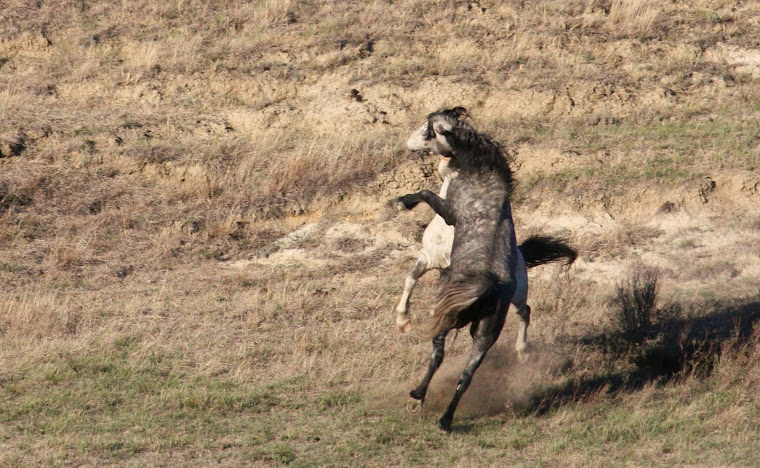
Not wanting me to get too close to the foal, Lignite started back to her band. Sensing an opportunity to steal another mare from Red Face, Sidekick approached her to bring her into his band grazing not too far from the larger band. Red Face was in a small valley and didn't see that his mare was about to be taken, but Satellite did see Sidekick and immediately sensed his intentions. Satellite ran to intervene while Lignite wheeled to try to protect Little Mo from the battle which she knew was about to irrupt. Satellite challenged Sidekick and both horses reared in defiance of one another. Satellite had beaten off Sidekick handily and was about to claim the mare for himself when Red Face showed up. I have never seem Red Face fight Satellite, but it has always been clear that Red Face is dominant over Satellite. Satellite was soon running from Red Face.
Twice more Red Face had to run off Satellite so it appears to be a matter of time before Satellite deserts his post as body guard to Singlefoot and acquires his own harem. It will be interesting who he will take them from. Will it be Red Face or Singlefoot, or will he take on another stallion? Only time and more observations will tell the rest of this story.
Last year Red Face had no foals, leading us to wonder if he was able to settle his mares, but this year every mare he had in his harem foaled a healthy foal. Singelfoot lost two foals last year to unknown causes and only has one this year. Two more of his mares carrying this year's foals have yet to deliver. Though they have been successful in increasing their bands by reproduction, they have each lost mares in the past month. One would think their cooperative effort would make taking their mares more difficult, but Red Face has lost Firefly and her filly, Rue, to Sidekick and Strawberry, her three year old colt, Eclipse, and her new filly, Medora to High Star. Singlefoot has lost Molly and little Teddy Bear to Red Face and Bentonite and Sapphire to Wind Canyon.
On the hottest day of our last visit to the park, Jan and I hiked far into the interior of the park to an area that looks fairly flat from a distance but is laced with deep valleys. We felt it was worth a long hike on a hot day to find four bands in the same area and we wanted to check on Sidekick's little filly, Funny Girl, who was limping badly. We called in Henry and Hedrick, the other observation team, to help us work the larger bands in such rolling country. While they were coming, we were able to work Embers and his band. There was nothing new happening with them.
Moving a little closer to try to get all of Red Face and Singlefoot's bands in sight, we were able to see that Sundance had a solid bay filly with her. We also noticed a lone horse about five hundred yards fr0m the others. With the sun behind her, she looked dark chestnut and had me stumped for a time, but I finally realized it was the young black mare, Lignite. Since she was alone, I figured she must have a brand new foal with her too. Moving a little close yet, I was able to confirm that she had a cute black filly with her that was no more than a few hours old. She had most likely been born some time during the early hours of the morning and they had not yet returned to Red Face's band.
Not wanting me to get too close to the foal, Lignite started back to her band. Sensing an opportunity to steal another mare from Red Face, Sidekick approached her to bring her into his band grazing not too far from the larger band. Red Face was in a small valley and didn't see that his mare was about to be taken, but Satellite did see Sidekick and immediately sensed his intentions. Satellite ran to intervene while Lignite wheeled to try to protect Little Mo from the battle which she knew was about to irrupt. Satellite challenged Sidekick and both horses reared in defiance of one another. Satellite had beaten off Sidekick handily and was about to claim the mare for himself when Red Face showed up. I have never seem Red Face fight Satellite, but it has always been clear that Red Face is dominant over Satellite. Satellite was soon running from Red Face.
Twice more Red Face had to run off Satellite so it appears to be a matter of time before Satellite deserts his post as body guard to Singlefoot and acquires his own harem. It will be interesting who he will take them from. Will it be Red Face or Singlefoot, or will he take on another stallion? Only time and more observations will tell the rest of this story.
Subscribe to:
Posts (Atom)