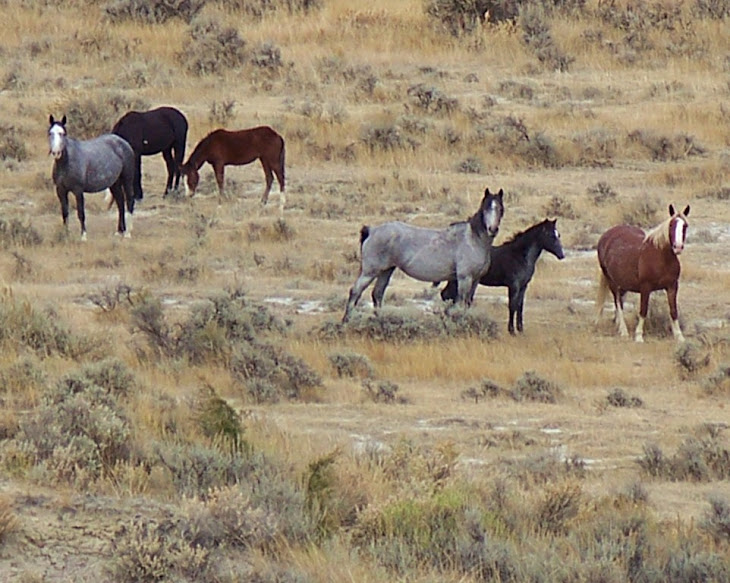
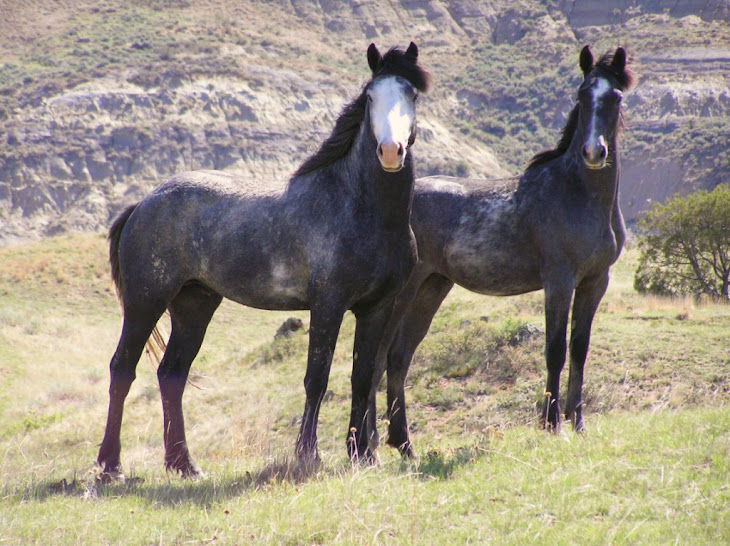
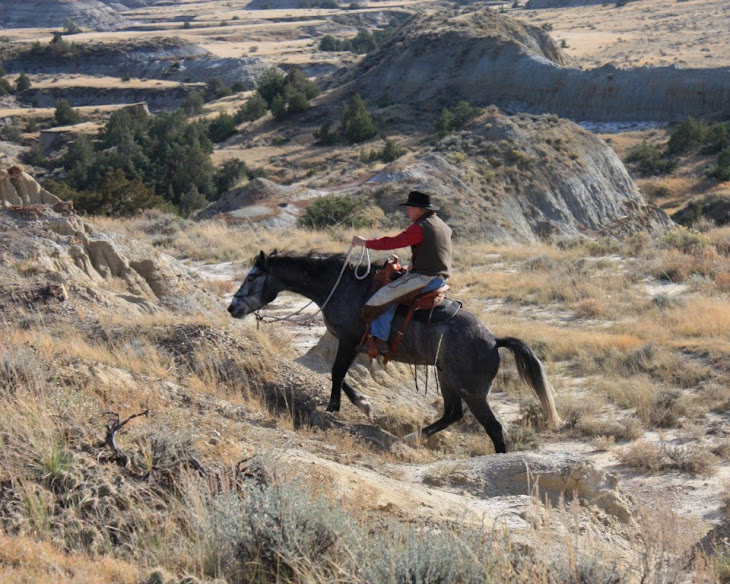
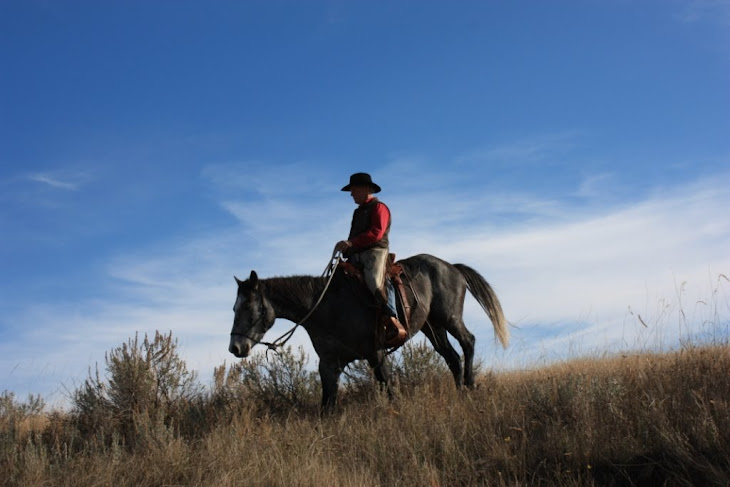
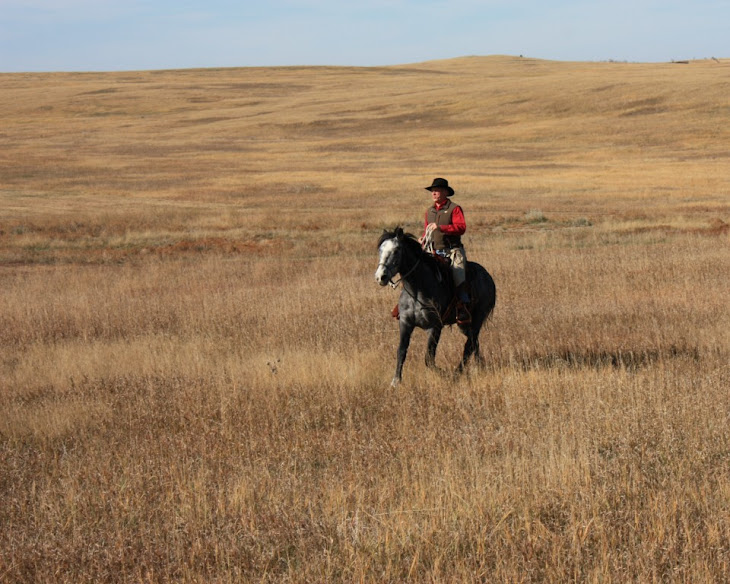
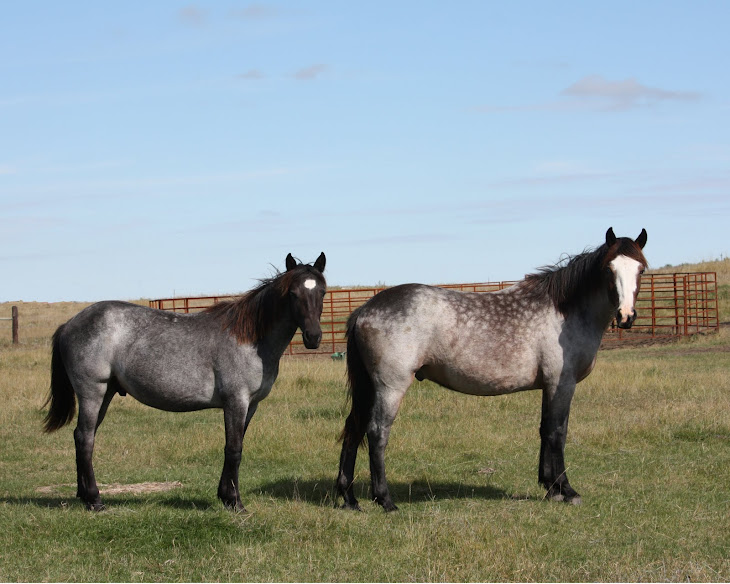
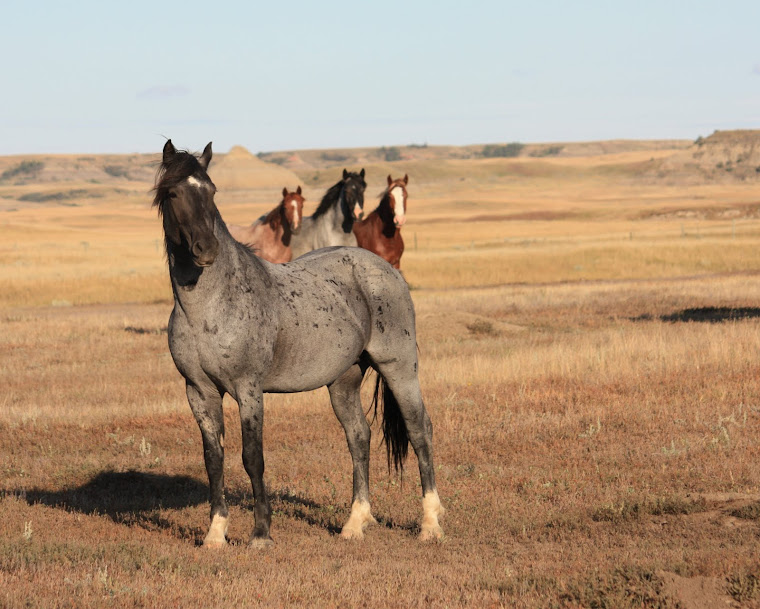
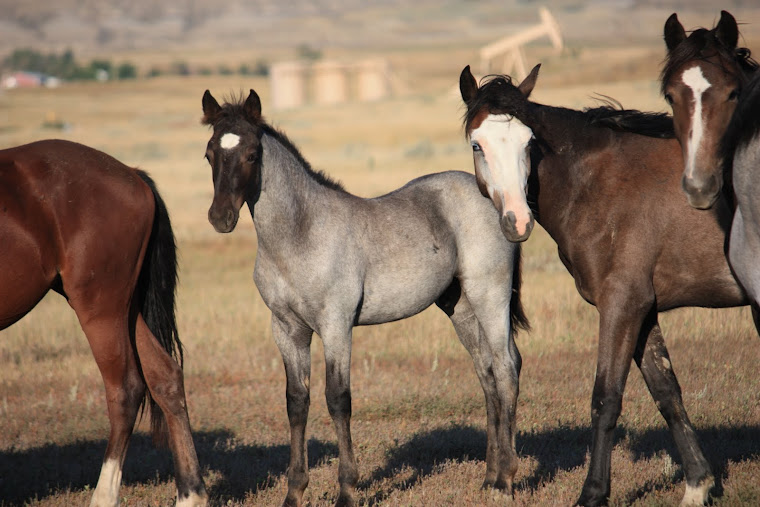
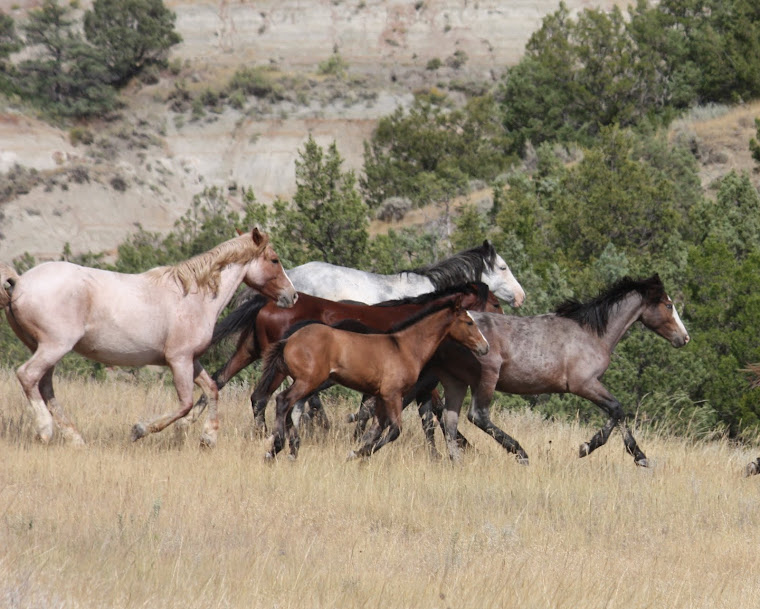
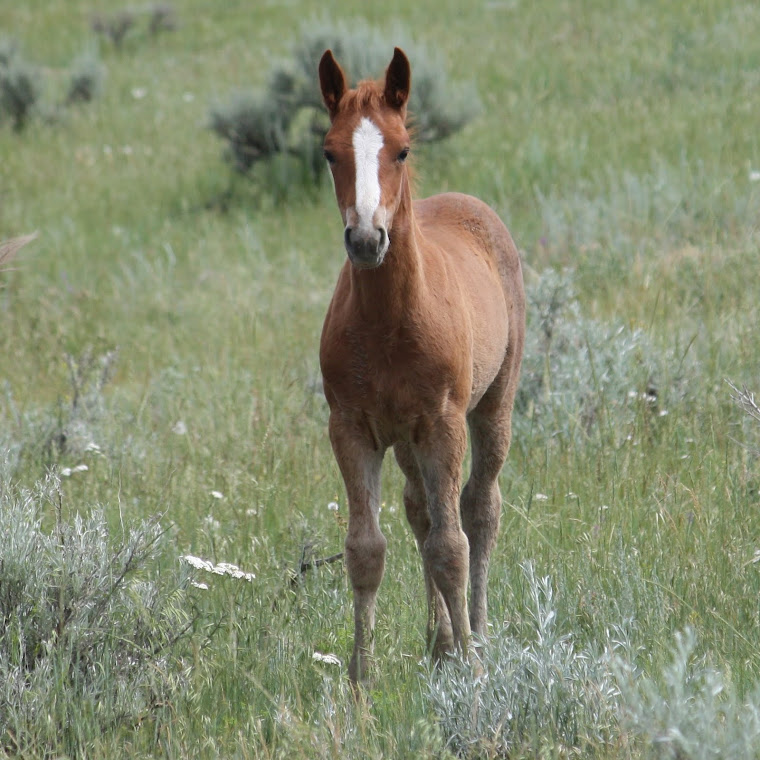
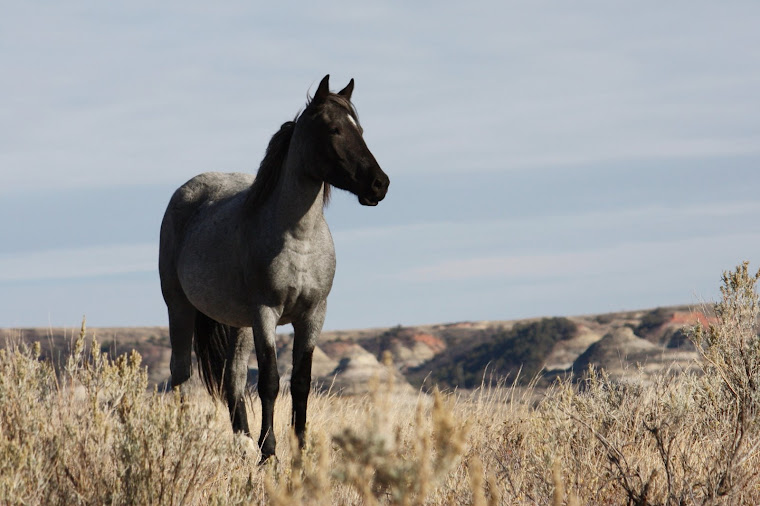
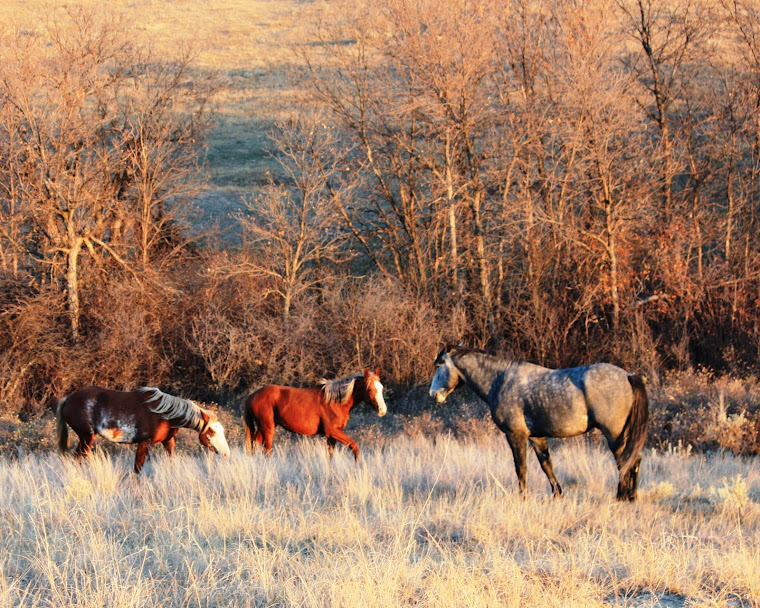
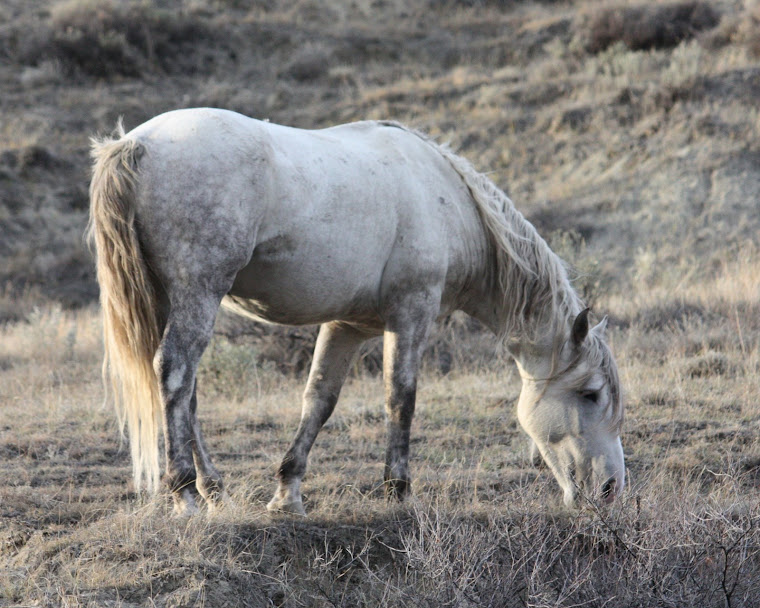
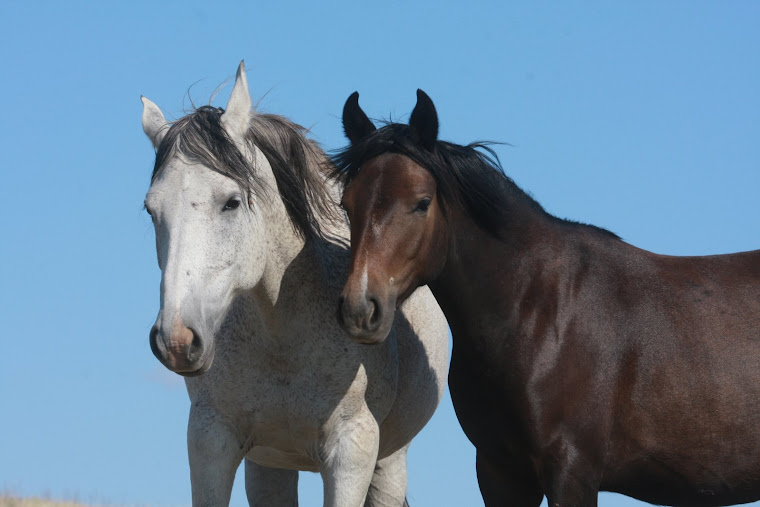
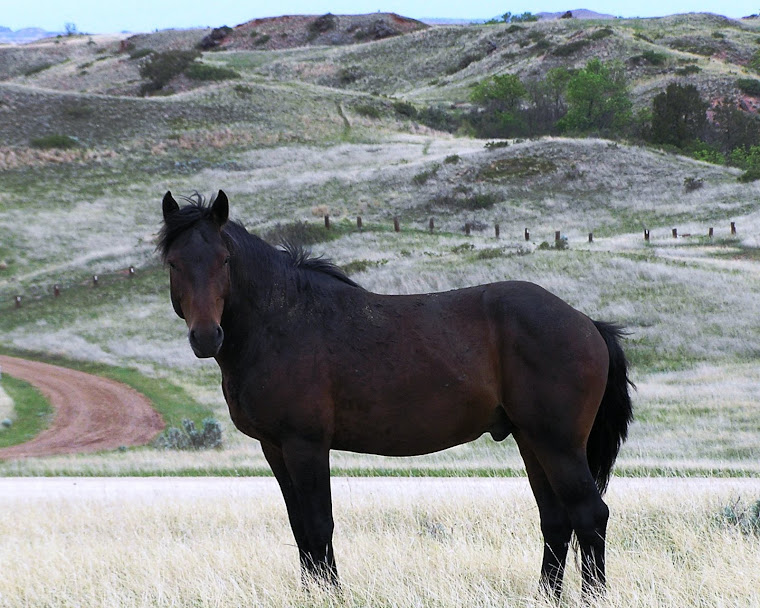
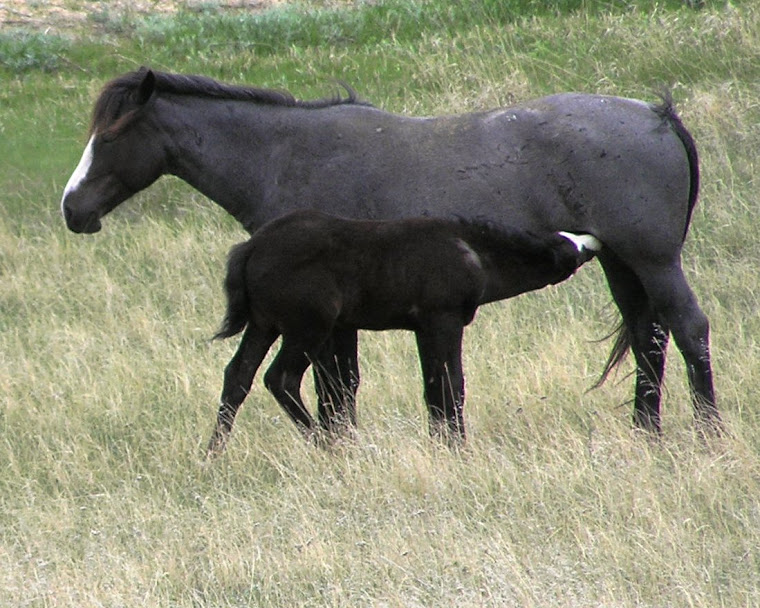
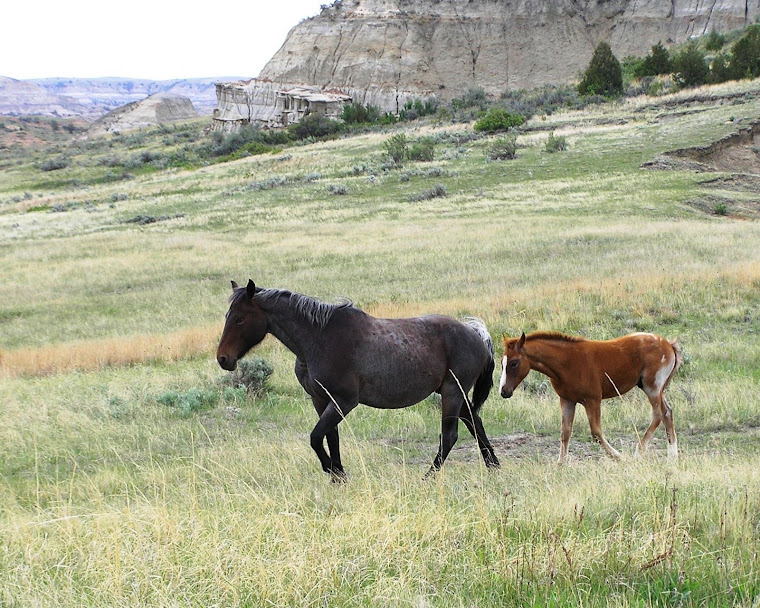
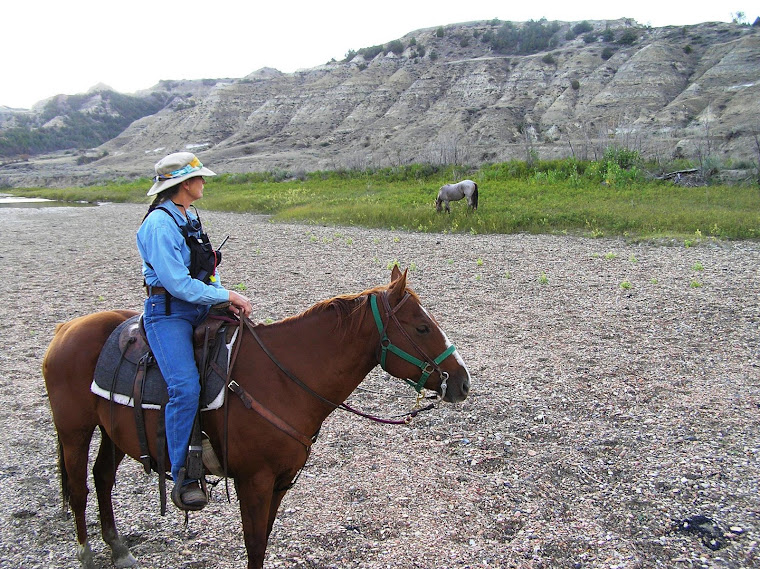
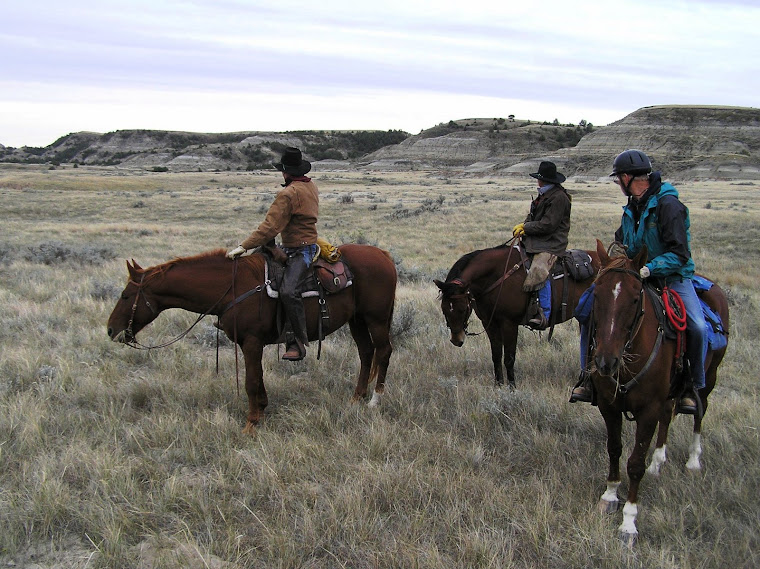
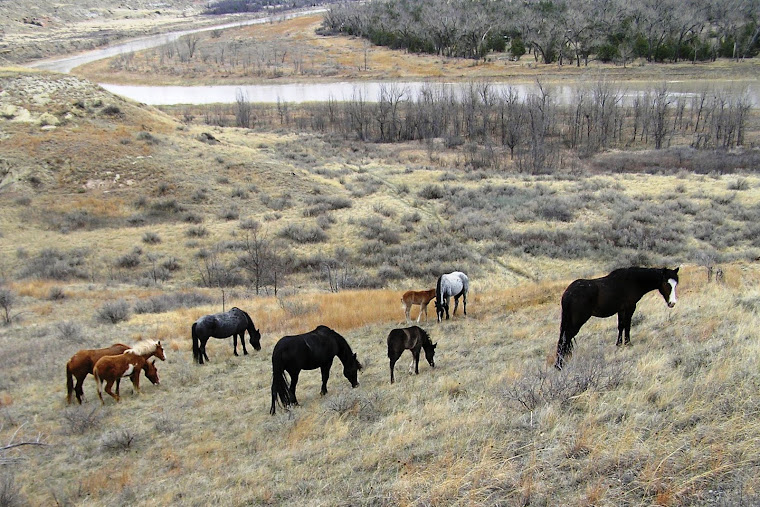
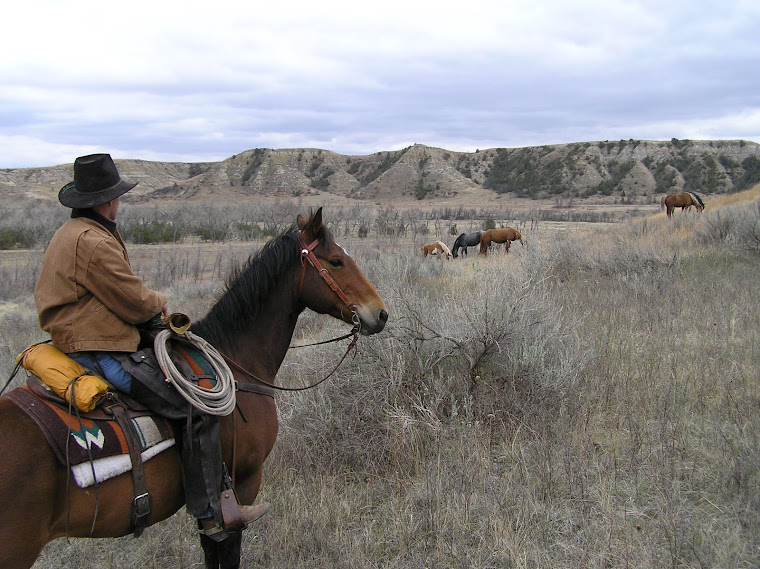
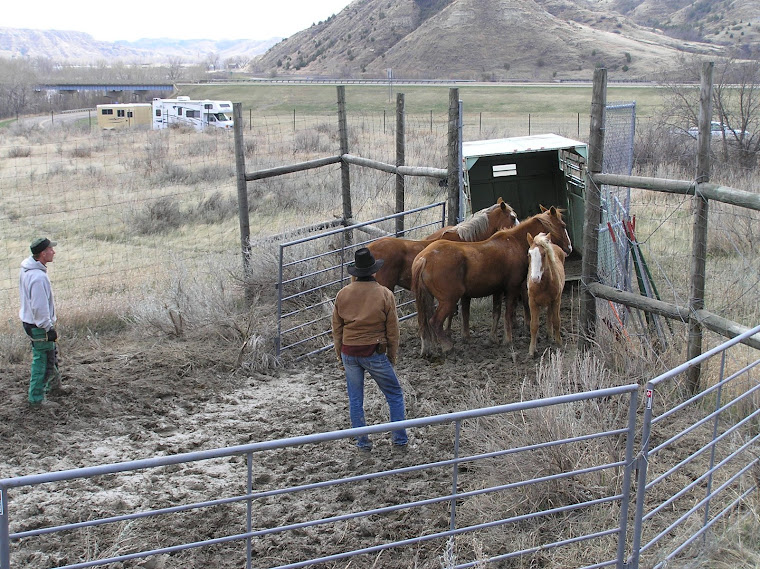
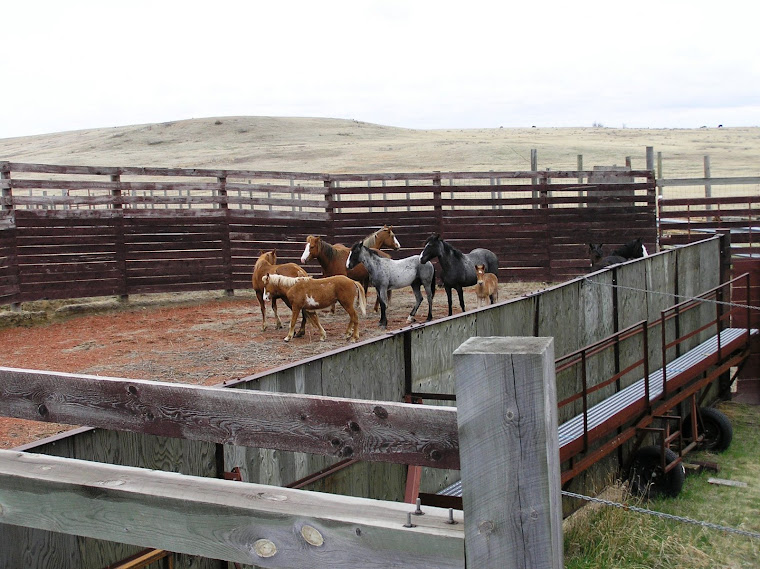
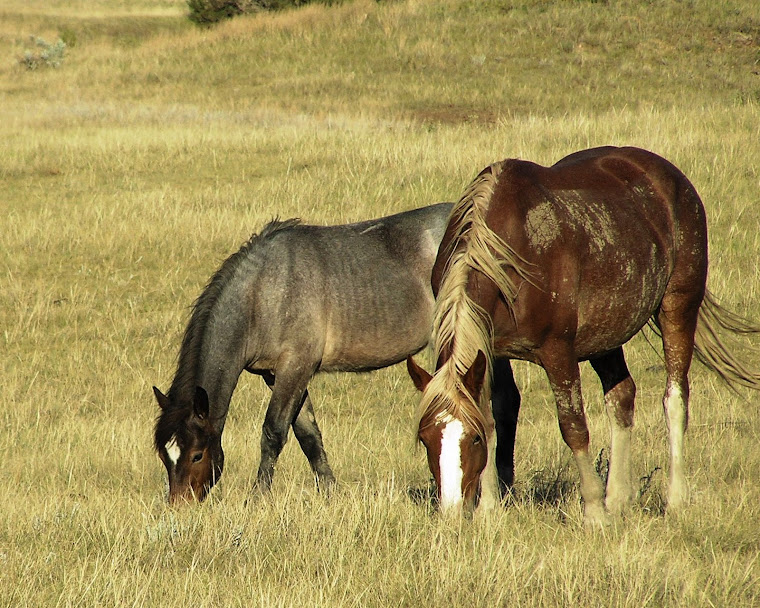
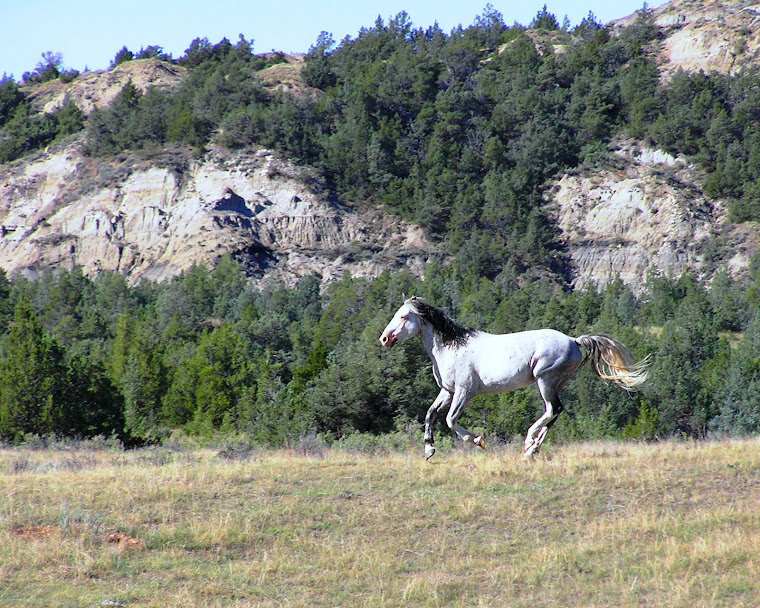
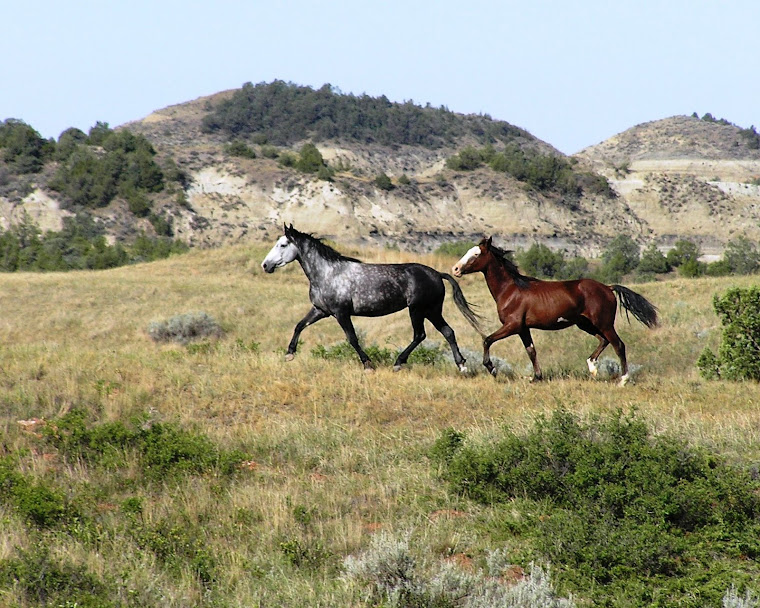
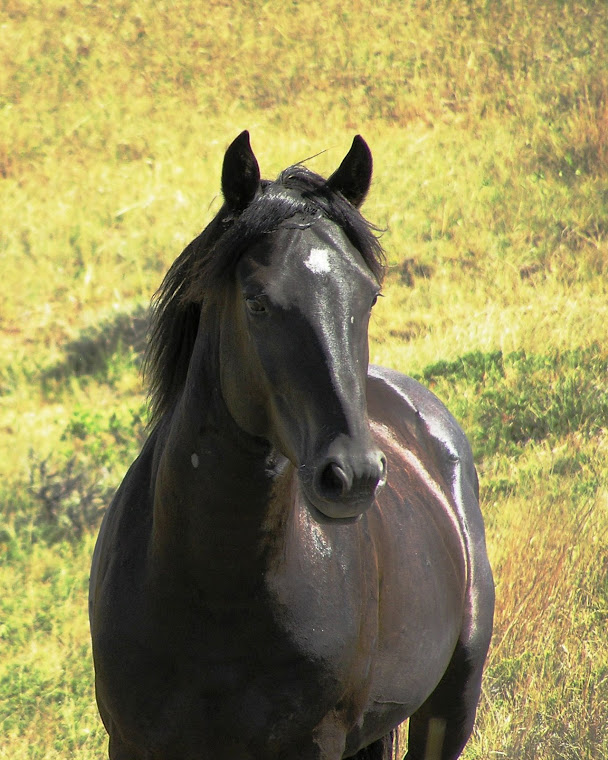
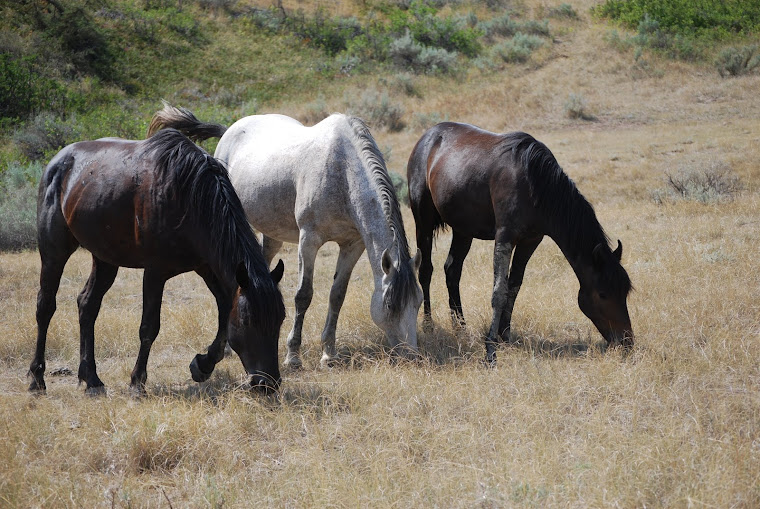
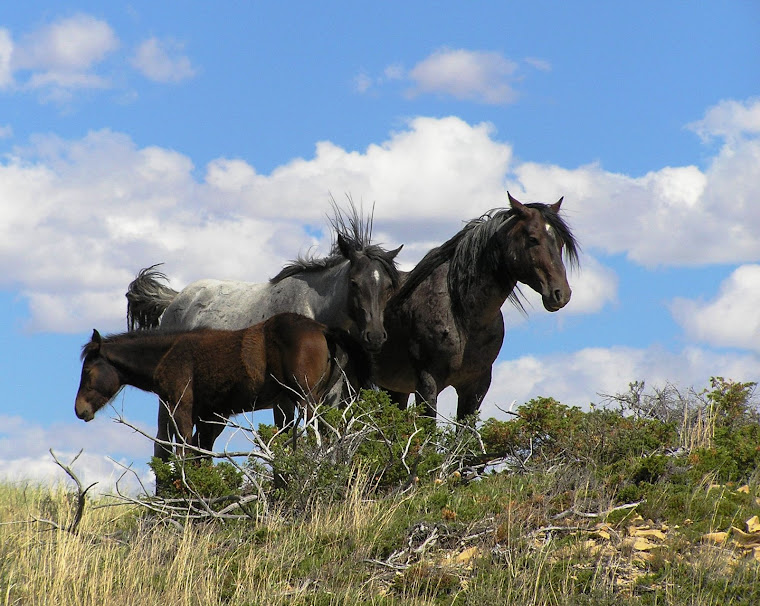
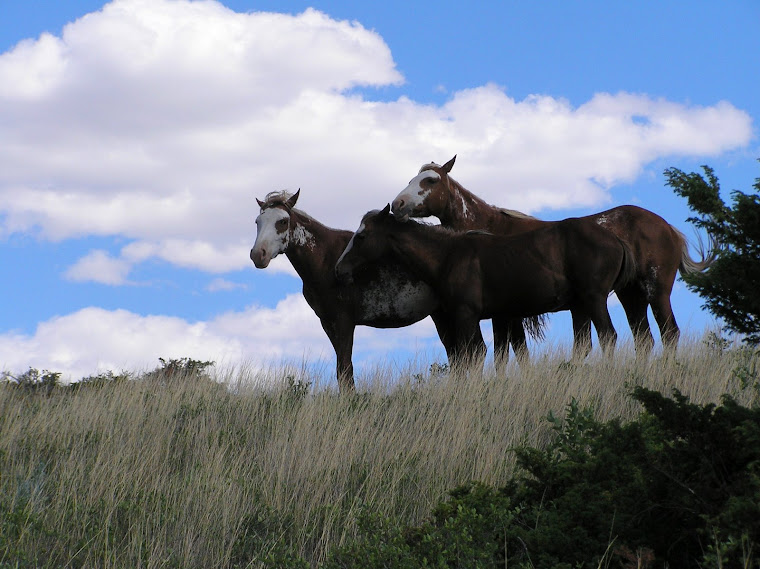
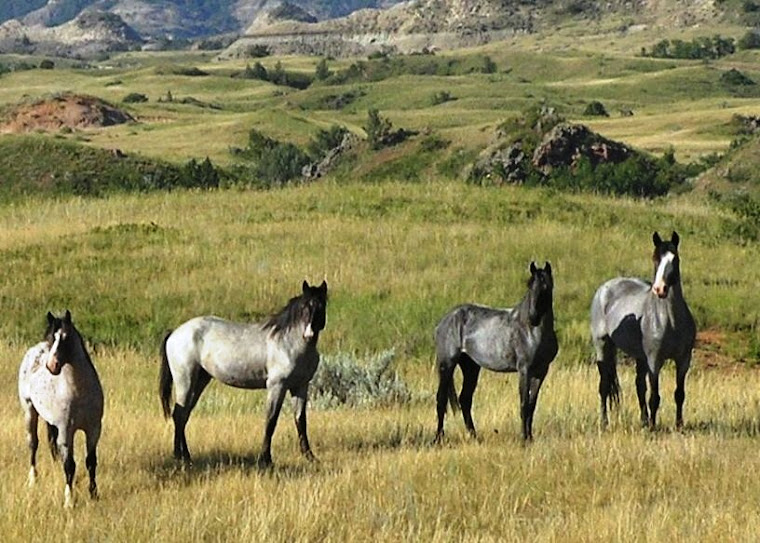
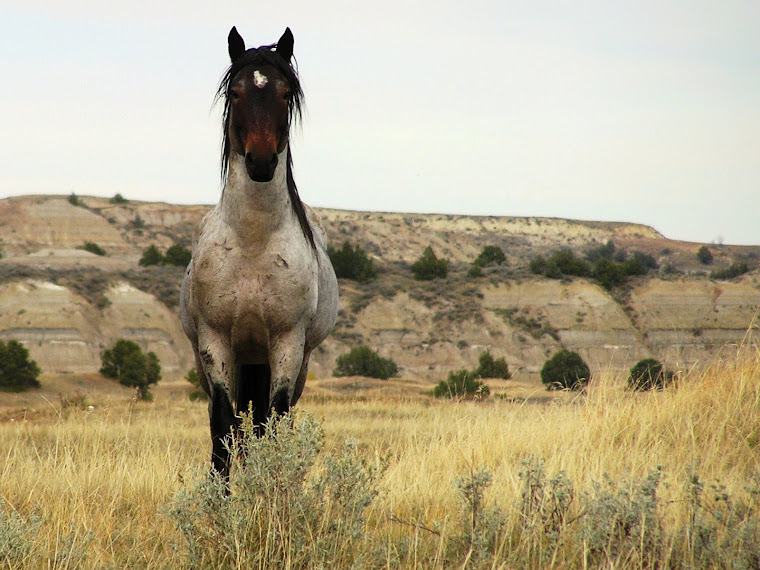
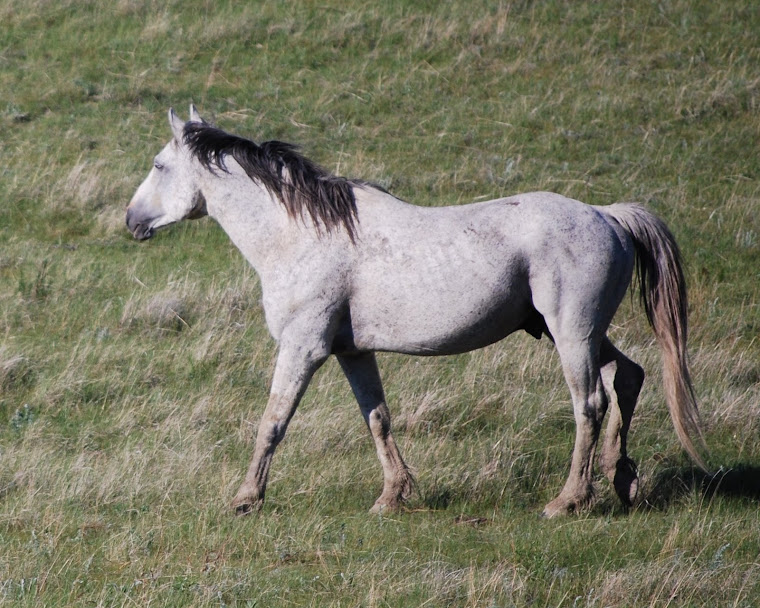
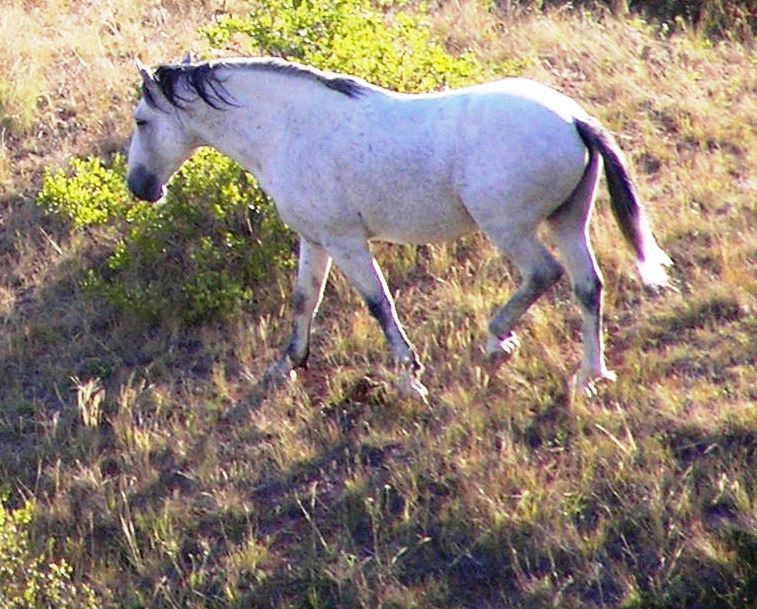
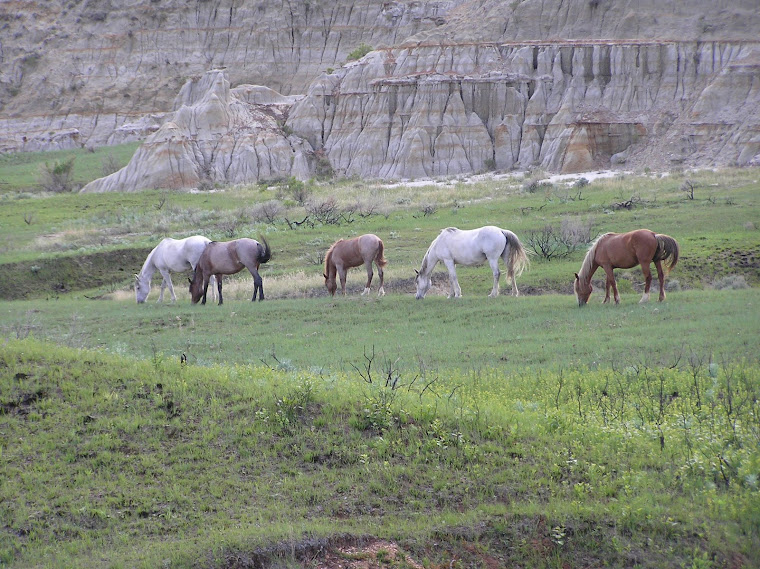
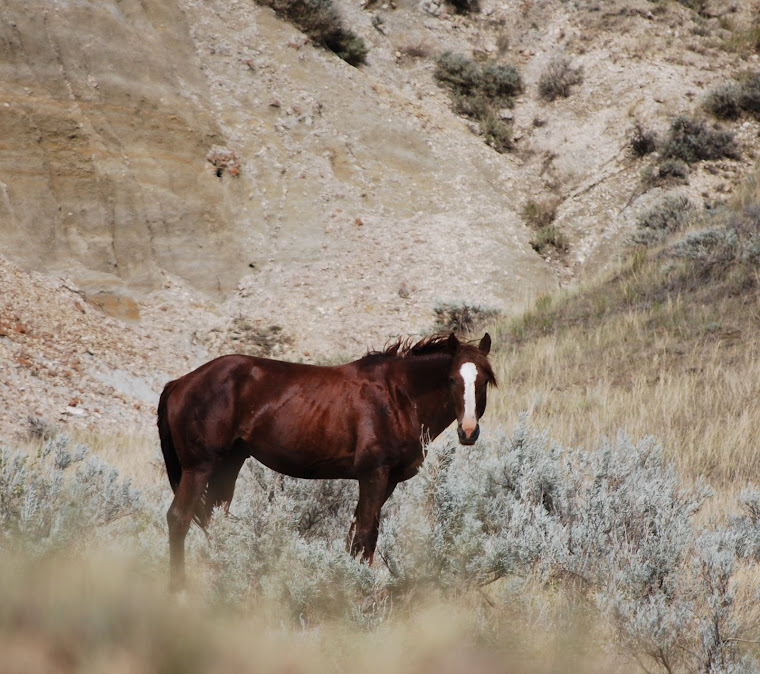
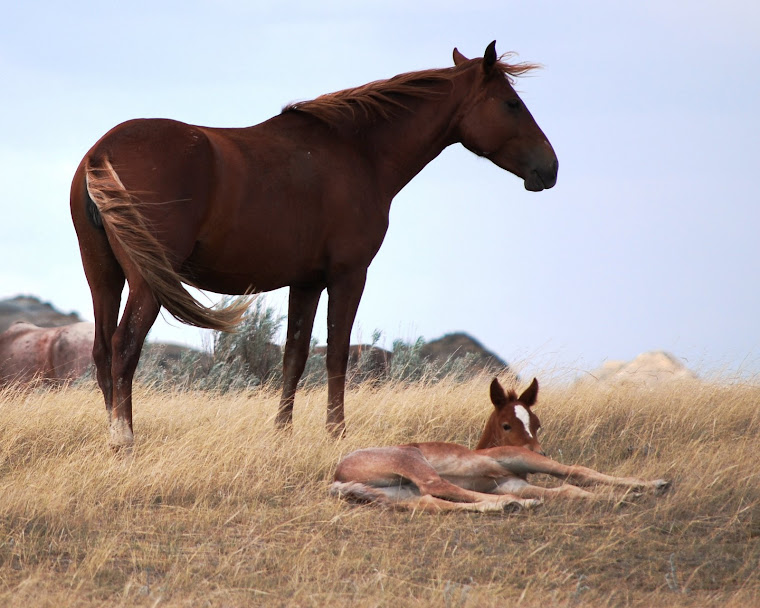
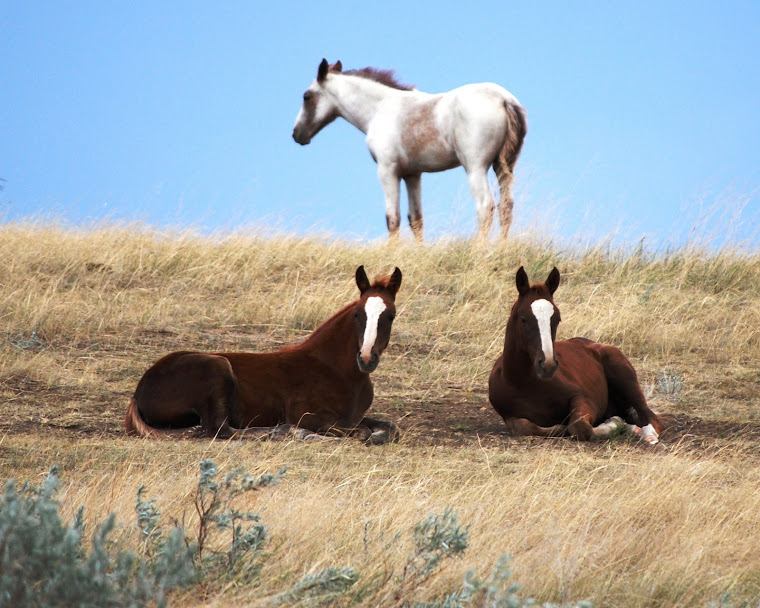
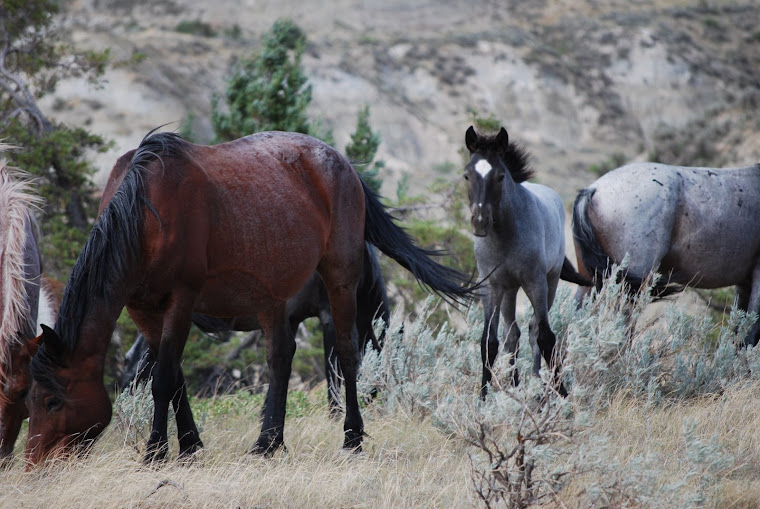
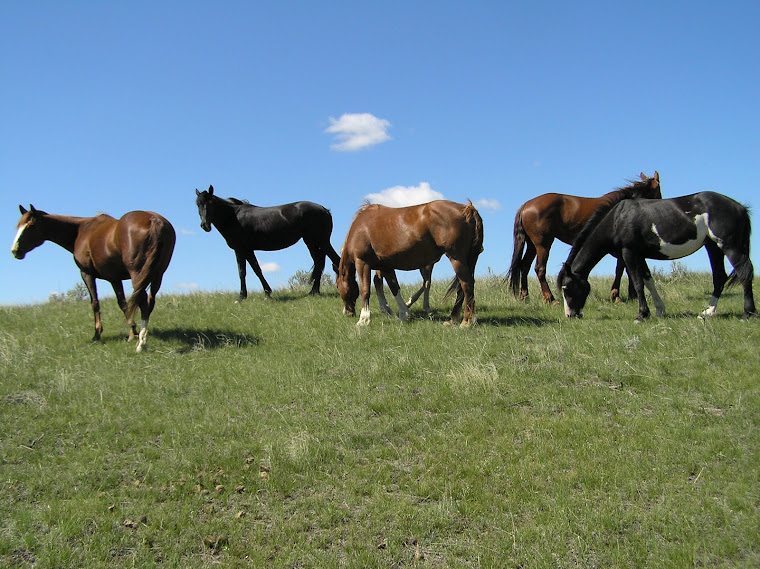
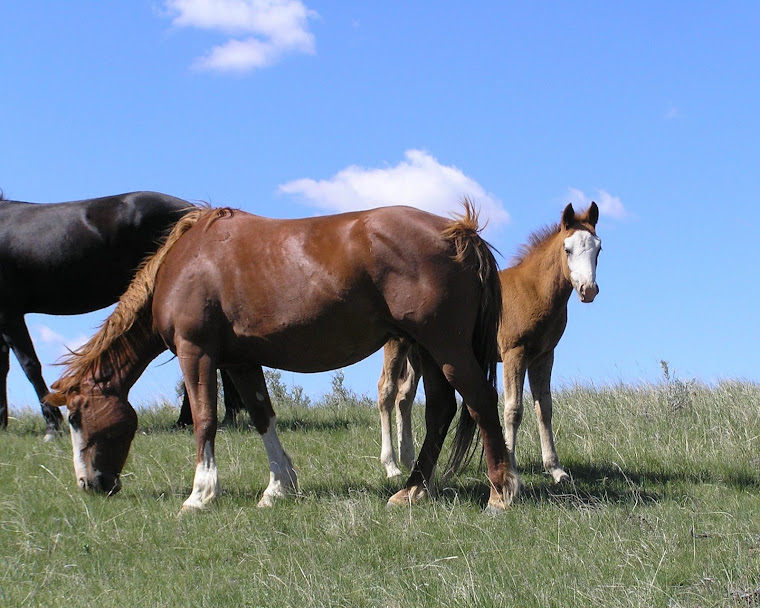
Since I don't have a photo yet of Paddock, or Paddy for short, the last foal to introduce now is Buck, in Little Sorrel's band. He is another cute bay from the mare, Trouble's Girl. Since Grandma Roan lost her foal this year, he in the only one so far in that large band. He appears to be doing well, and I would expect him to roan like his mama and his older brother, Butte.
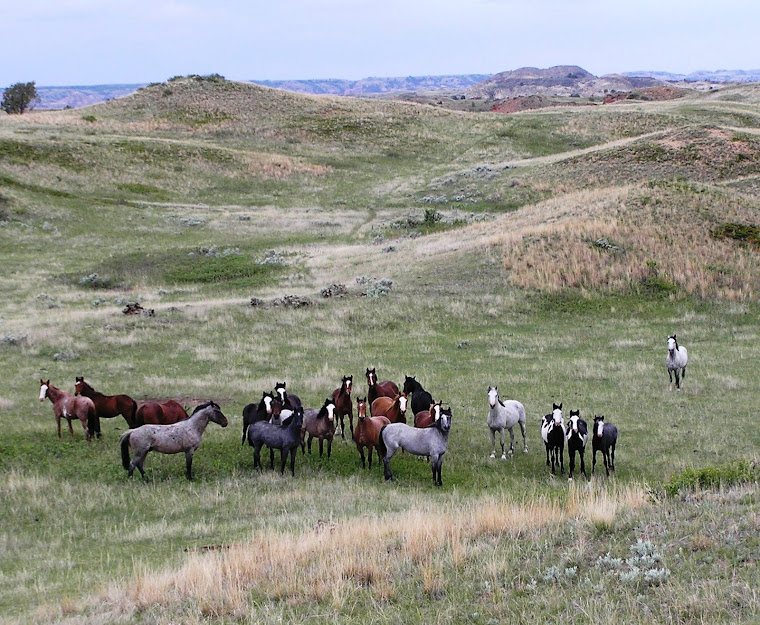
The Little Sorrel band has been interesting to watch as Little Sorrel ages and loses some of his youthful vigor. He has been successful in running off all his stud colts as they get old enough to challenge him except for the four year old, Cruiser, who is also one of Trouble's Girl's colts. Trouble's Girl is from the mare, Trouble, who was the thorn in The Chestnut's side, as she was always dragging her family away from his band to join other bands. Trouble's son, Double Trouble was also very hard for The Chestnut to chase away, as he would stay on the other side of his dam whenever The Chestnut tried to get near him.
Cruiser has been irritating Little Sorrel since last year. When we first located the band to do the behavior study, Little Sorrel had just run Cruiser off, but by the time we were done, he was back. The odd thing is that we have seen Little Sorrel leave Cruiser in charge at various times.
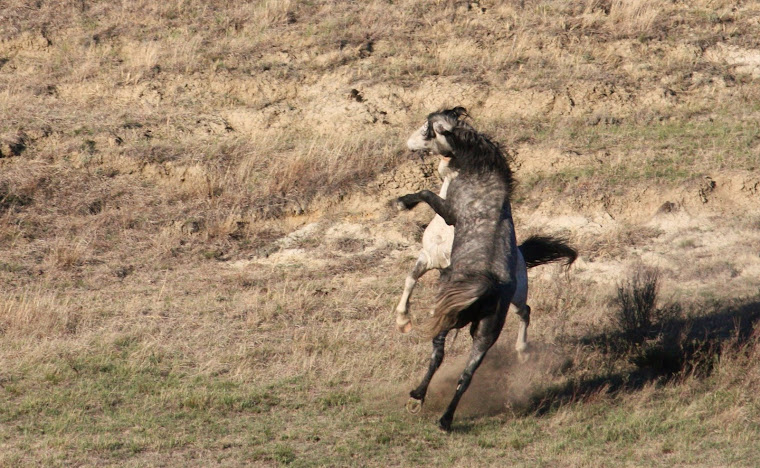
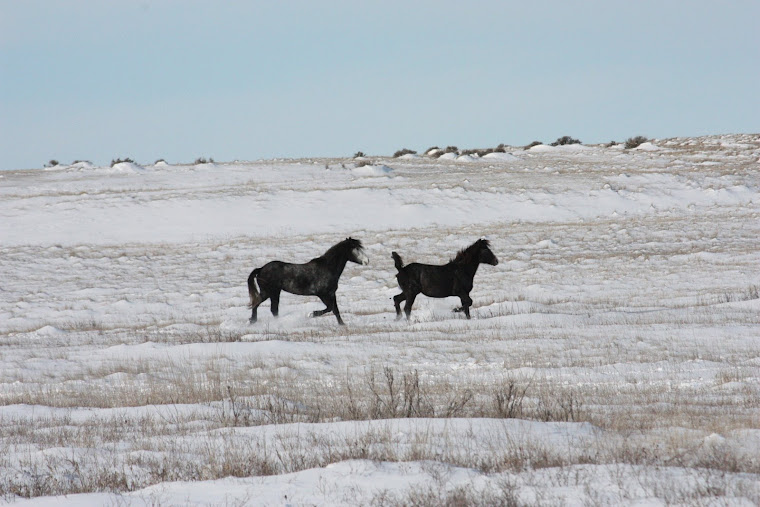
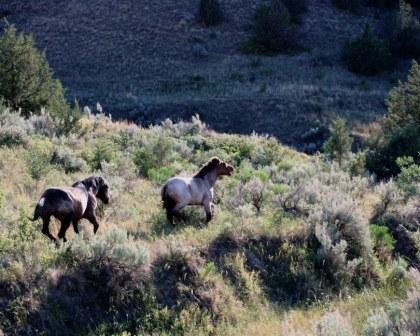
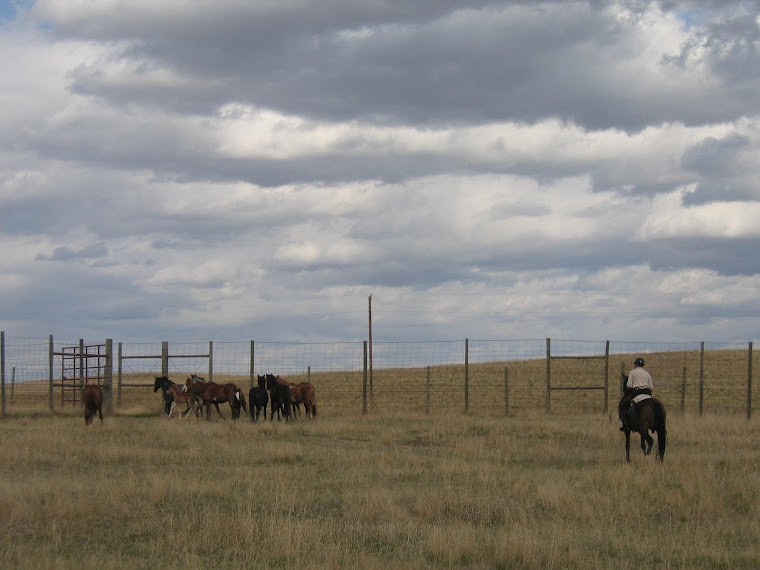
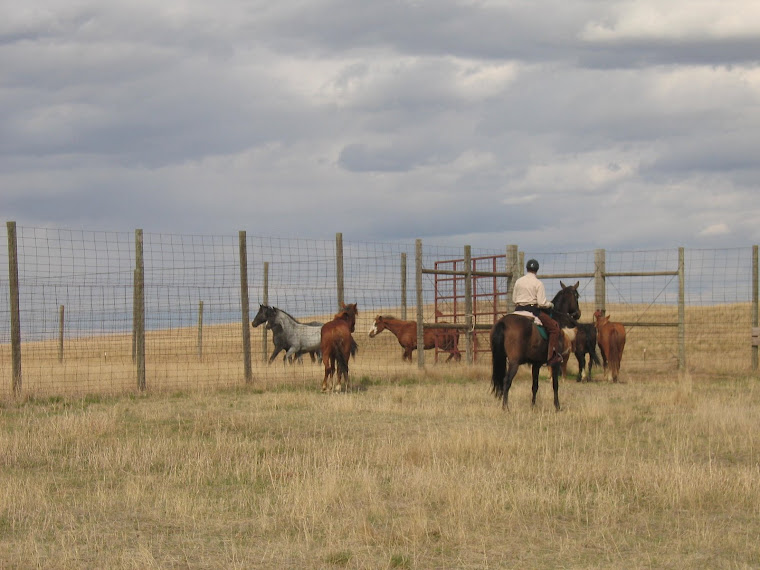
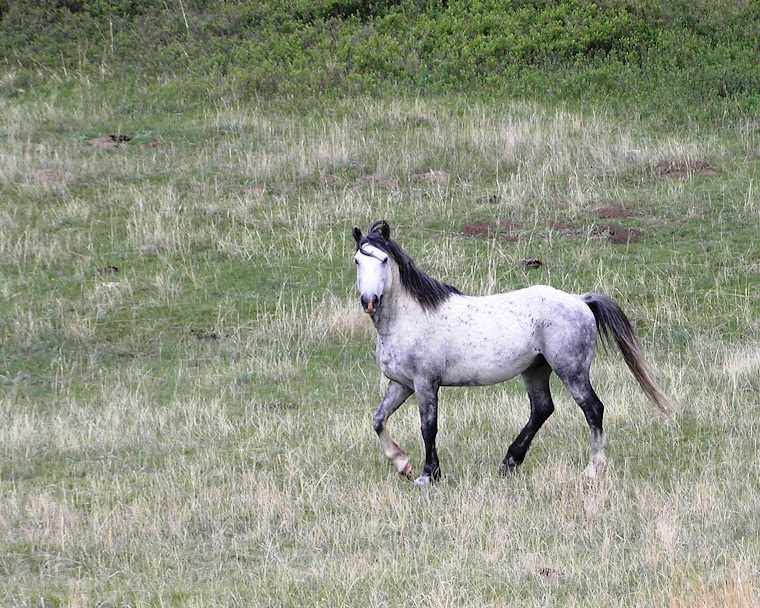
For an example, the second day we found the band by the old entrance to the park. At first we had not seen Cruiser. A blue roan stud that appeared from the east, turned out to be Shadow, one of Grandma Roan's stud colts. Shadow was taking his time to approach the band, so Little Sorrel had not yet seen him. About the time Little Sorrel saw Shadow, Cruiser reappeared. Little Sorrel left his band to Cruiser and went out to meet Shadow. We were prepared to witness a fight or at least a good chase, but what we saw puzzled and amused even Jason, the wild horse behavior expert the Park had brought in to train us. Little Sorrel went to meet Shadow, they pranced and circled in a show of strength, squealed and stomped at one another, and then Little Sorrel trotted off in the opposite direction from his band with Shadow following obediently behind. Little Sorrel led him across the valley, over the butte, and out of sight. (see series of photos below) We were not able to stay for the rest of the story, but we were determined to find out what would happen.
Later that day when we checked on them, Cruiser had claimed a mare, her two offspring, and a couple young stud colts. Not far away were Shadow and Granite's Boy, another young bachelor looking for trouble. On the last day of our visit we ran across Shadow with a mare and two young fillies. Yes, they were the ones Cruiser had claimed. Cruiser was back to hounding Little Sorrel. We left them in another game of "catch me if you can". It will be interesting to see the saga continue over the rest of the summer.
The last band we were to collect data on that trip was Mystery's. We had been seeing him and his three mares periodically throughout the six days of our visit. Looking for bands from the top of Buck Hill on the last day, Jan, our new friend and data collector from CO, saw Mystery with a new mare. She saw him mount the mare, but then they all dashed away toward the east end of the loop road. We had almost given up on finding them when I spotted them across the road to the east, just north of Talkington trail.
I was excited to see that the new mare was Lacey. I had not seen her since last summer when she disappeared from Embers' band. It was clear from her behavior that she was in estrus, but the curious thing was that whenever Mystery would show interest in her and come her way, the old mare, Gray Lady would threaten him or kick at him. We watched them for an hour and every time Lacey tried to approach Mystery or he showed interest in her, Gray Lady ran interference, herding her away. We had a good question for Jason, our trainer; how do we report harem tending by a mare?
Sunday, April 26, 2009


Saturday, April 4, 2009
A LONG HARD WINTER IN THE BADLANDS
Will it never end? That must be the question going through the heads of the wild life and horses who have survived one of the longest, coldest, and snowiest winters in the last 30 years. Just last week the Park received another 12 inches of snow. I don't know what the total is for that area, but Bismarck has had over 99 inches this season. We are 1.8 inches from breaking our all time record of 101 inches in the winter of '96-'97. One advantage is that it will ensure a good growth of vegetation once the snow melts off and the sun warms the frozen ground.
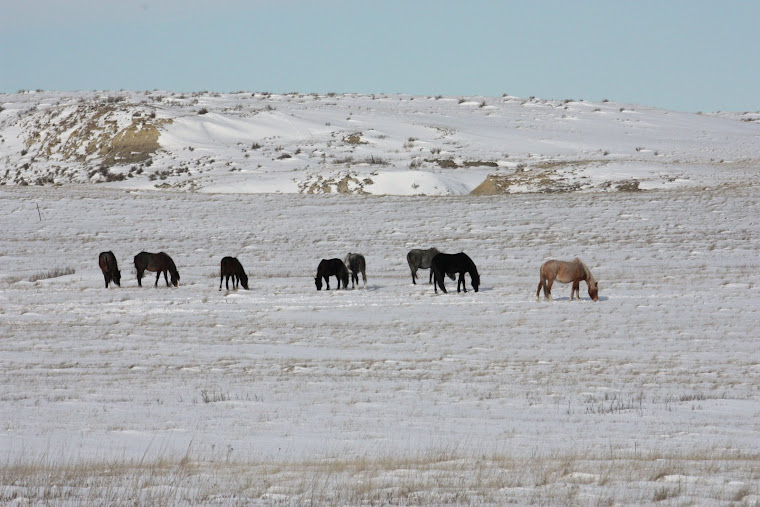
We like to make a trip to the Park for our Anniversary in late December, so after Christmas we spent a couple days in the Park enjoying a fresh blanket of snow. We had seen High Star's band in the SE corner of the park on our way to Medora the first morning. It was pretty tough going through the deep snow, but we were able to get close enough to them for a few photos. All looked as if they were faring well, even with the deep snow they had to paw through for every bite. Baldy and Bashful trotted over for a visit while we were there, but High Star was not interested in neighborly niceties and ran them off.
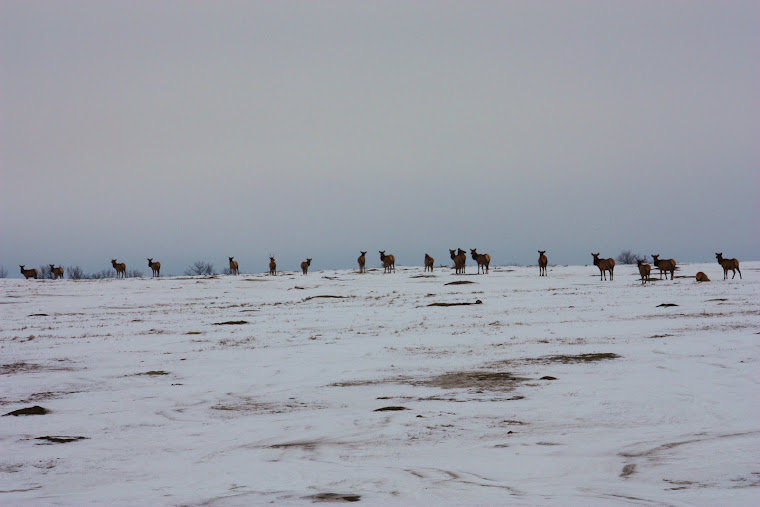
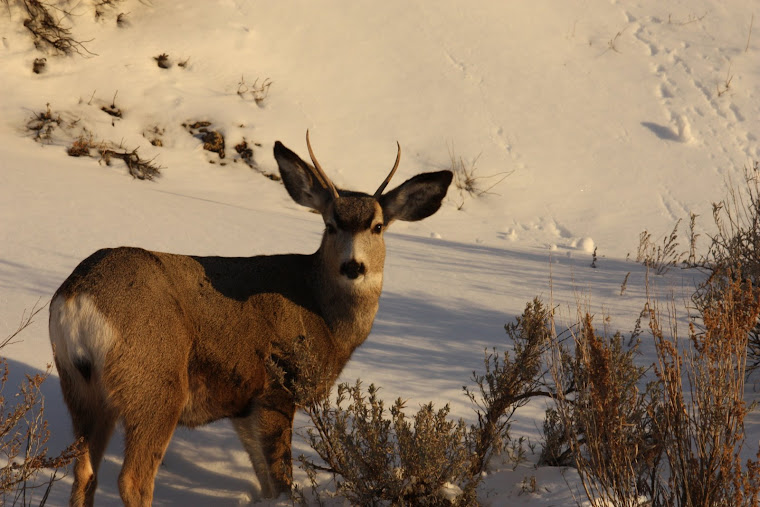
Since the Park had so much snow, the loop road was closed; we spent the rest of that day skiing the Little Missouri. The snow was excellent for cross country skiing and the weather was perfect with bright sun and very little wind. It is always a thrill to see the buttes in their winter dress, like something from a Bev Doolittle Painting. The next day we hoped to see some more horses when we skied up the loop road on the north side of the Park. We got about two miles in before the weather turned cold and windy, so we high tailed it back to the car before we got caught in a storm. The only wild life we saw on our skiing trek was a very cooperative Cotton Tail, but there were numerous deer, bison, and elk along the main road.
In early March I was able to return to the Park with some friends. We missed the first break up of the ice on the Little Missouri by about 12 hours. From what we heard, it was quite impressive. ( read about this on Ranger Nathan's blog. http://rangernathan.blogspot.com/ )
The loop was still closed but we found Brutus and his fillies, Dolly and Autumn, near Wind Canyon. Dolly appeared to be in foal, but it is probably Embers' foal, since he had her in his band from May until September. Further up the road to the east we found Cocoa, Busy Blue with her yearling, Amigo, and Stormy with her yearling, Rusty. The two year old fillies, Maggie and Maddie were missing. Along the road, against the warm south side of a high river bluff, we found Curious George. Though he was thin and shaggy, he seemed to be well.
On April 3 we were able to go out with Mike Oehler, the Park Biologist. From the Fryburg road we saw Thunder with his mares, Rain and Winter, and their offspring as well as High Star with his band and a couple additions. Sweetheart and her two year old, Oreo, were with them. We were surprised to see that Sweetheart had been taken from the double band of Singlefoot, Red Face, and Satellite.
On the way back to town, we spotted four young bachelors on the south bluff, overlooking Cedar Canyon. Farther west, we crawled under the fence to get a better look at Little Sorrel's band. He was missing a few, some of which we found later with Gray Ghost and some we suspected were with the young stud, Cruiser.
Being with Mike, we were able to take the loop road deeper into the Park. Much of the road was still covered with 6-8 inches of snow and one drift on Boicourt Ridge forced us to turn around, but we were still able to find several more bands. Red Face, Singlefoot, and Satellite had four new foals with them. Two foals had been sited earlier, one with Copper and one with a young stud, Cloud, who had acquired the old mare, Flicka, so the count is five stud colts and one unknown for now.
It is a wonder how those tiny foals survive the cold and storms that still rage through the breaks in the spring, but the horses of the Badlands are made of sturdy stuff. For their sake and our own, we will pray for warmer temperatures as we look forward to another trip to the Park in two weeks.
We like to make a trip to the Park for our Anniversary in late December, so after Christmas we spent a couple days in the Park enjoying a fresh blanket of snow. We had seen High Star's band in the SE corner of the park on our way to Medora the first morning. It was pretty tough going through the deep snow, but we were able to get close enough to them for a few photos. All looked as if they were faring well, even with the deep snow they had to paw through for every bite. Baldy and Bashful trotted over for a visit while we were there, but High Star was not interested in neighborly niceties and ran them off.
Since the Park had so much snow, the loop road was closed; we spent the
 rest of that day skiing the Little Missouri. The snow was excellent for cross country skiing and the weather was perfect with bright sun and very little wind. It is always a thrill to see the buttes in their winter dress, like something from a Bev Doolittle Painting. The next day we hoped to see some more horses when we skied up the loop road on the north side of the Park. We got about two miles in before the weather turned cold and windy, so we high tailed it back to the car before we got caught in a storm. The only wild life we saw on our skiing trek was a very cooperative Cotton Tail, but there were numerous deer, bison, and elk along the main road.
In early March I was able to return to the Park with some friends. We missed the first break up of the ice on the Little Missouri by about 12 hours. From what we heard, it was quite impressive. ( read about this on Ranger Nathan's blog. http://rangernathan.blogspot.com/ )
The loop was still closed but we found Brutus and his fillies, Dolly and Autumn, near Wind Canyon. Dolly appeared to be in foal, but it is probably Embers' foal, since he had her in his band from May until September. Further up the road to the east we found Cocoa, Busy Blue with her yearling, Amigo, and Stormy with her yearling, Rusty. The two year old fillies, Maggie and Maddie were missing. Along the road, against the warm south side of a high river bluff, we found Curious George. Though he was thin and shaggy, he seemed to be well.
On April 3 we were able to go out with Mike Oehler, the Park Biologist. From the Fryburg road we saw Thunder with his mares, Rain and Winter, and their offspring as well as High Star with his band and a couple additions. Sweetheart and her two year old, Oreo, were with them. We were surprised to see that Sweetheart had been taken from the double band of Singlefoot, Red Face, and Satellite.
On the way back to town, we spotted four young bachelors on the south bluff, overlooking Cedar Canyon. Farther west, we crawled under the fence to get a better look at Little Sorrel's band. He was missing a few, some of which we found later with Gray Ghost and some we suspected were with the young stud, Cruiser.
Being with Mike, we were able to take the loop road deeper into the Park. Much of the road was still covered with 6-8 inches of snow and one drift on Boicourt Ridge forced us to turn around, but we were still able to find several more bands. Red Face, Singlefoot, and Satellite had four new foals with them. Two foals had been sited earlier, one with Copper and one with a young stud, Cloud, who had acquired the old mare, Flicka, so the count is five stud colts and one unknown for now.
It is a wonder how those tiny foals survive the cold and storms that still rage through the breaks in the spring, but the horses of the Badlands are made of sturdy stuff. For their sake and our own, we will pray for warmer temperatures as we look forward to another trip to the Park in two weeks.
Saturday, February 28, 2009
FIRE'S STORY
It had been three years since the last roundup, but the early years of the new millennium had treated the horses of Teddy Roosevelt very well. Twenty nine foals had been born over the warmer months of 2003, and by fall they were strong and plump from feasting on their dams' rich milk.
A couple handsome colts had been foaled to the Embers band. Since his years as a young bachelor, Embers had been a favorite of ours and Tom's. His dark bay coat was specked with white like a soft dusting of new snow and his mane and tail flowed long and black as a raven's wing. He was a well built stallion, who had impressed us with his proud stature and protective nature. His colts, one from a pretty red roan mare and one from the mare Tom called the "dirty brown mare," were both bay roans but lighter than their sire.
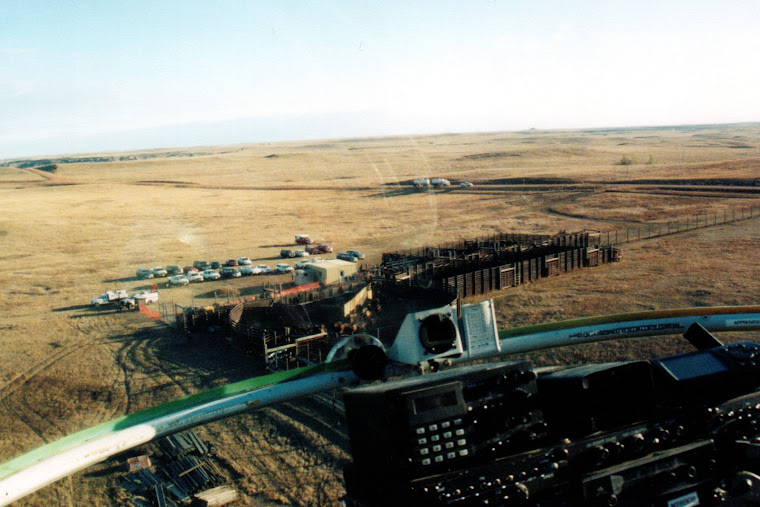
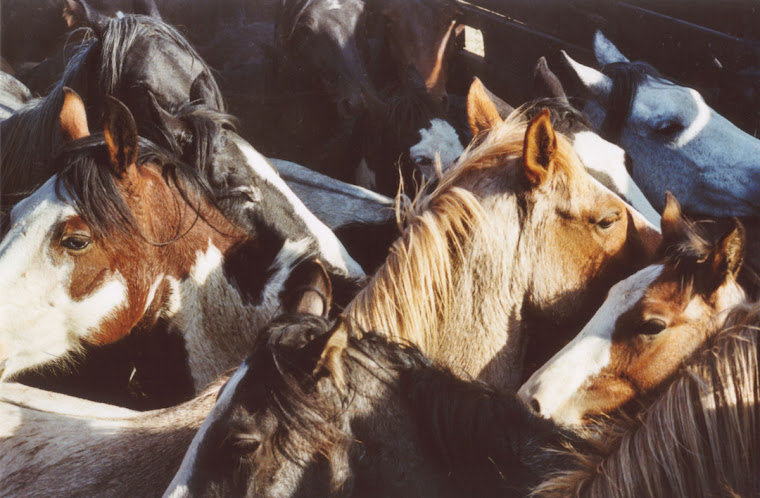
That summer I worked meticulously getting photos of all the bands and individual horses so that I would know who was who when they were driven from the breaks and valleys further out in the Park into the handling facility by the helicopter. Tom customarily rode in the helicopter to guide the pilot in herding the horses, while Henry and I waited at the handling facility to identify the horses as they were moved though the facility, into the chute, and into the keeper or cull pens. It was determined that about two-thirds of the foals would be sold at auction after the roundup, but I had not even thought about the possibility of bringing any home.
After a successful roundup Henry and I looked over the horses that had been captured, remarking about how cute some of the foals were. Later that evening, Henry asked what I thought of buying one of the foals; he apparently had been contemplating the idea over the summer. I was a little surprised, but knew that he would be needing a good trail horse, so we looked at what was available on the cull list. There were some extremely cute foals from the Interstate band, but I didn't think they would get big enough for Henry, so I suggested seeing what Embers had.
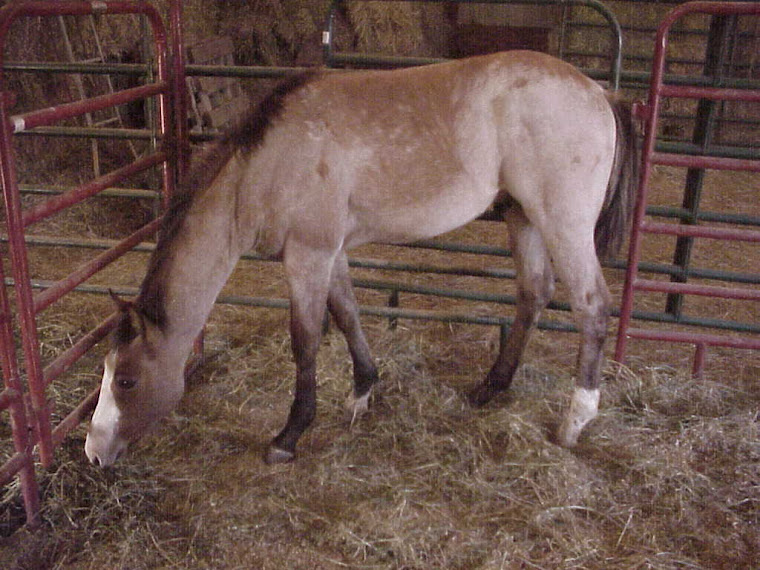
We discovered that he had the two colts in the sale, so Henry decided to pick one of them. By the time we got to the sales barn in Dickinson, that sale had already started. The first colt came in with his face cut up. Since the colts were wild, it would be pretty hard to get him stitched up, so Henry waited for the next one. Before very long the colt from the "dirty brown mare" came into the sales ring. He was big and strong and, though frightened and confused from all the sights and sounds of a sale barn, he seemed to handle the stress without panic. We hadn't even had time to take a good look at him, but he looked pretty correct from where we sat, so Henry bought him. He named the the pretty bald faced bay roan colt Embers' Fire after his sire.
The first obstacle was to get him safely loaded in our trailer without injury. Since we still had our saddle horses with us, Henry just moved them both to the front or the four-horse, leaving the back section open. While Henry was getting the trailer ready and backed up in the loading area, I visited the colt in his pen, getting him used to me and familiar with the principles of pressure and release. Rather that letting the sale barn hands chase him, I carefully pressured him enough to get him moving and then backed off. He walked right into the trailer.
The first several days, we had to keep Fire in the barn because we hadn't been prepared for a wild horse and didn't have a pen with high enough fences. We soon found out that the pens in the barn were also not sufficient to contain a wild foal. Though he seemed to be depressed from the traumatic experience of being chased by a helicopter, separated from his family, and brought to a completely strange environment, he would not tolerate being left alone. My old Quarterhorse, Badlands, had to become his constant companion and Henry had to reinforce the pen so that he could not destroy it trying to get out when Badlands went for a drink of water. Except for not wanting to be left alone, Fire was quite calm and easy to gentle. From the very beginning of being in the trailer we could pet him , so getting him halter broken was not a problem. He didn't much like the farrier, but with some patience he soon accepted whatever handling he needed
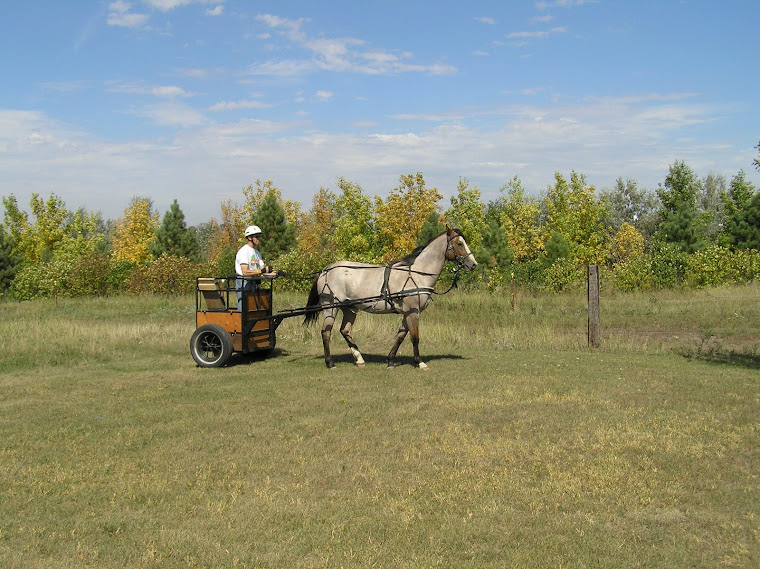
In his second year Fire went for his first schooling. Though he was very calm, Fire tended to meet each new challenge with irritation and a fight responce rather than acceptance. His new teachers, Russel and two gargantuan draft horses, taught Fire about submission. He soon learned that fighting a new and somewhat frightening situation was fruitless and started to think that what this persitent man and his team wanted from him was not that difficult. While he was in training Henry and I would go for visits to learn how to harness and drive him safely. After a couple months, we were able to drive him around the back roads of that rural North Dakota community and soon brought him home.
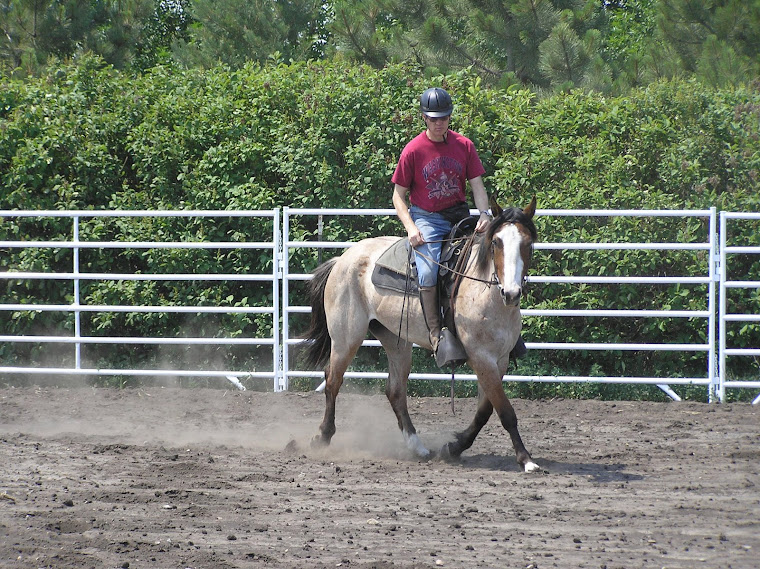
The following year Fire went to Zachery for training under saddle. Again he proved to have a strong will, but when handled with a firm, yet patient, kind approach, he accepted his new job without any rodeo tricks. Since Zachary was a champion saddle bronc rider, he would have been able to handle anything Fire could have given him, but Zachery is a believer in making the right thing easy and the wrong thing difficult, so that the young horse figures out what is expected of him before getting too frustrated and turning off his brain. Fire was soon making his turns and transitions like a pro. Both Russell and Zachery had enjoyed working with the once wild colt and Henry was excited to ride Fire back in his natal prairie and breaks.
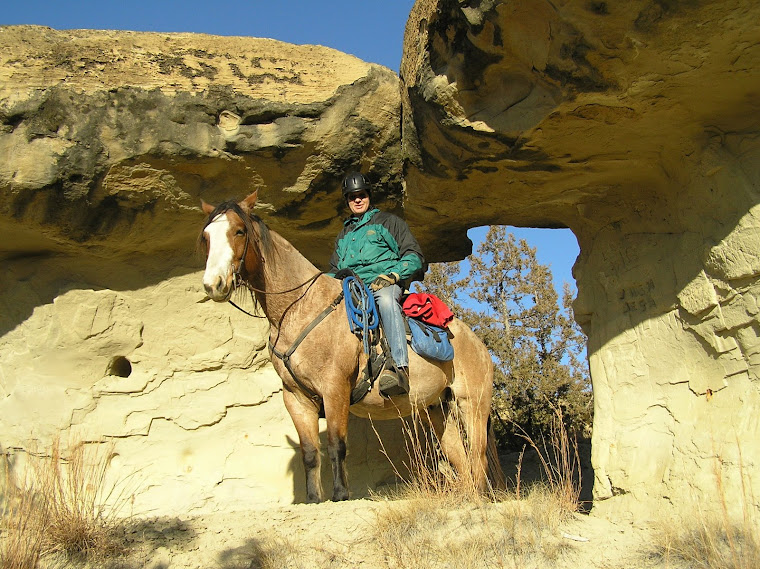
The opportunity came that fall. Fire easily handled the terrain he had been born in and, unlike most domestic horses we have taken to the badlands for the first time, he was never nervous about gully crossings or the occasional Bison bull lurking around the sunny side of a butte. Another characteristic that separated Fire from other horses was that he would not pass up any opportunity to drink. Even the rain filled tracks of Bison and other horses were good sources of drinking water; his mama had taught him well to get his drinks when he could, not knowing when the next chance might be. To this day Fire has proved himself to be a strong, sensible saddle horse and, at 15.2 and around 1200 pounds, quite a striking boy.
Saturday, October 4, 2008
Whit Comes Back
It was late September and Whit Hibbard was back to give a refresher seminar on the low stress livestock handling method and and teach park employees with some hands on experience. Whit brought his colleague, Samantha, who has studied the method and worked with Whit on the ranch and at Big Bend. We spent one day showing Samantha the park, the handling facility, and what horses we could find from the truck, talking strategy of which bands might be the best to approach and where would be the best place to try to pen them.
Friday morning was the short seminar where we were reminded of the main points of low stress handling: work with the animals, not against them, don't act like a predator, let our idea become the animal's idea, make the wrong thing difficult and the right thing easy with pressure and release. Personnel were able to practice the techniques with some domestic horses and cattle that afternoon.
Henry and I opted to ride out with Samantha to check out the sheep pen, make sure the gate was locked on the south side, lay a trail to the pen so that there would be fresh horse scent on the trail, and scout for the bachelors we had seen in the area the day before. We were able to find only one bachelor, but approached him to see how large his flight zone was. He was totally unconcerned with us, so we thought he would be a good option for another field trial to see if Whit could repeat the success he had with the L band earlier this year.
Since we wanted to find the five other bachelors we had seen with "Ollie," we spent the morning scouring the hills and valleys for about a mile either side of the river, but were not able to find any more horses. Whit took a couple hours to take the lone stud to the sheep pen, and with Samantha's help was able to pen him.
The next day we rode from the handling facility. I spotted High Star in the distance on Talkington Trail, so we rode to the north to get around him. While we were covering that distance, High Star and his band of seven moved to Lindbo Flats. We were able to approach them and shrink their flight zone some, but there were 39 other horses in the area, milling around and playing on that cool, windy day, so it was difficult to get the band to settle. Before we got very close to them, Pale Lady decided it was time to leave and even evaded High Star's attempt to head her off. We took a look at several other small bands on the flats and were able to move one small band of bachelors to the east, but then a large group of over 20 horses came toward Whit and Samantha, cutting around the ridge about 30 feet in front of them taking the bachelors with them. The whole 47 horses ran in circles as if to show us that they were to happy to be free and didn't want to cooperate with us.
The following day we tried another tactic, finding the horses from the loop road. Henry and I went out early and found four bachelors on Paddock Creek where the road crossed it. We were able to call Whit and tell them where to park to unload their saddled horses. We now had most of the day to move the small band down Paddock Creek Valley to either the Peaceful Valley Ranch pen or the sheep pen. We decided it was best to have only Whit and Samantha work with the horses and the rest of us including our friend, Laurie, from the North Unit, guide them from high vantage points along the way.
On this cool morning these bachelors were also feeling frisky, but after a time of acclimating them to his and Samantha's presence Whit initiated some movement down the valley to the west. I had told Whit that the trail started on the south side of the creek but then crossed and remained mostly on the north side the rest of the way to the river, so it was his plan to move them slowly along the bottom just south of the creek until he could cross them over to the north side. Suddenly the bachelors had other plans and ran up a valley to the south. Whit and Samantha followed them and were able to find them stopped on the high ground below the Badlands Overlook where another bay bachelor joined them. We were able to observe all this from a high butte from which we could call Whit and Samantha with locations of the horses and possible routes to try once they were able to move them again.
After some time of getting them to settle down, Whit attempted to move them again the to west. They went west initially, but since they had a bachelor from the B band with them, he wanted to go back to the east and turned them back. Whit was again able to follow them back east where they turned onto the loop road. With Whit trailing along behind, they followed it for several miles. We hadn't thought of such an obvious route to get from the rough country below Badlands Overlook to the relative rolling terrain of Johnson Plateau, but it certainly made the going easier for Whit and his horse.
Laurie and I went ahead, opened the ranch pen, and left her horse in an adjoining pen for bait, but the bachelors decided they wanted to go south and once they reached the river bottom, they headed straight for the sheep pen. Henry and I took off at a brisk trot for the sheep pen to get it open before the band reached it. Whit and Samantha held them up until we could get there and get out of the way. At one time a group of hikers frightened the horses up the ridge to the west and Whit thought they were gone, but they came back down. We joined Whit and Samantha about a half mile from the pen and shadowed them as we asked them to move again. The horses were at first wary of the additional riders, but accepted us and started down the trail. By that time the two lame bachelors had dropped out, so there were only three left. They were all used to running on the river bottom, so it was a familiar place to them. They moved quietly along the trail until they came to the wing fence which was made of plastic snow fence. If it was the fluttering, shiny snow fence of just the appearance having nowhere to go, I do not know, but they suddenly broke and ran for the river and through a thick stand of Cottonwood and Juniper. The day had been long and was coming to an end. Whit decided not to follow. We had failed to pen the additional bachelors, but was it really a failure? Whit had been able to move the horses several miles through rough terrain and bring them right to the mouth of the sheep pen. Maybe with a larger opening and better wing fencing we would get them in another time.
It was certainly an adventure Henry and I will never forget. We gained more respect for Whit's skills to be able to do what he had just done. We gained new respect for our horses, who had been up to the challenge of taking us safely across the rough terrain for four long days. We gained priceless experience and insight as to the effectiveness, but difficulty of using the low stress methods in this park and we gained two great new friends in Whit and Samantha. All in all it was a very successful five days.
Oh, yes, and Ollie? we let him go.
Friday, September 19, 2008
Whisper's Story
It was a crisp fall day when I first saw her, a tiny sorrel overo filly romping with her bigger, blue roan brother. They bucked and reared together in the cool shadow of a large clay butte that kept the sunshine from reaching the river valley. Life was carefree for the two foals running through the tall green grass on the bank of the Little Missouri. The sun was still warm and the grass was still plentiful on that October morning, but the days were getting short and winter was not far away. God did not intend to have foals born in October; most of them were born in the spring or in the warm days of summer, but this little filly, with the big splashes of white on her sides and over her face and the promise of a flaxen mane fluttering in curly wisps down her neck, was less than a week old. She had no way of knowing of the brutal temperatures and relentless winds that would pummel the North Dakota prairie in just a few weeks. Those winds can barrel through the canyons like freight trains, freezing everything in their way. They freeze the river and water holes and bring snow that wets the hide and covers the rich grasses making every bite a chore. I wondered, would the newborn filly make it through a harsh North Dakota winter? I didn't see her that winter, so I could only guess about the safety of the filly and the two other late foals born that fall. I hoped that the snow would not be too deep and the temperatures not too severe.
The following spring I was anxious to check on the horses to see if all had survived. The winter had taken it's toll, but the cute overo filly was still with the L band, lounging in the protection of the great cottonwoods along the Little Missouri. The L band had a bad reputation for being pests in the park because of the home they had chosen. They found shelter in the brush and cottonwoods along the river bank where the wind didn't reach them in winter and the sun didn't scorch them in summer. They also found that the mowed grass of Cottonwood Campground was tender and green. They didn't mind that the lush grass was sometimes covered with a tent or a camper; they could share their home with visitors. What made them unwelcome was their discovery that the Redwood benches and signs in the campground were quite tasty. Being horses, they got bored once in a while and would find something to do that satisfied their chewing habit and tasted good too. The Park personnel had tried to run them out of the campground and even to capture them and send them away, but to no avail.
That spring the Park Superintendent, Valerie Naylor, contacted a low-stress livestock handler to teach the Park personnel some more effective ways to deal with animals who had escaped the park or the horses, whose numbers had made it necessary to sell some off so that vegetation in the Park would not be overgrazed. Whit Hibbard is a Montana rancher, who has learned the low-stress methods of Bud Williams and has used those methods successfully on his ranch and to capture trespass animals that have come across the Rio Grande into Big Bend National Park in Texas. Whit states that, "if done properly, low-stress livestock handling is more cost-effective and efficient, ethical and humane, and safer and easier for both people and animals than traditional livestock handling."
In early May Whit came to the Park and gave a seminar on low-stress livestock handling. Valerie graciously invited us to attend. The method uses many of the principles I was familiar with in natural horsemanship but on a much larger scale. Whit showed video of Bud separating and penning bull Elk and Reindeer as well as domestic livestock. He explained how one or two people could round up, pen, and load animals that would scatter with traditional methods. I found the methods fascinating and practical, but would they work with the wild feral horses of Teddy Roosevelt Park?
Whit had invited me to ride along with him the following day when he went to work with the L Band. All attempts to remove them from the area of the campground had failed, so he wanted to see if his methods might work. I showed up with a dressage horse, a dressage saddle, breeches, helmet, and a bitless bridle, but Whit wasn't quick to judge, he just asked, "Do you ever ride western?"
The river was raging from the rains that had been soaking the region for the past several days, so we loaded my horse and one of the Park's horses, that Whit was going to ride, into my trailer and drove to the other side of the river. We rode through the sheep pen, a sixty acre pen in the southwest corner of the park, that would be our destination if we were able to get directed movement from the horses. Just across from the campground, in a stand of young cottonwoods, we found the L Band.
Delicious was the band stallion of the L Band, having gotten his name because of what he would be in the frying pan of the trail riding concession providers if he didn't quit jumping in with their trail horses. His lead mare, Georgia, and three of the other mares were daughters of Curious George. He also had a nice blue mare that had been one of those to escape the storm and the roundup in 2003 by going across the river. There were 10 horses in all, four mares, two with new foals by their sides, a 2006 colt, a 2007 spring colt, and the little sorrel overo filly born in October.
Whit emphasized to me that the initial contact with the animals was of greatest importance; success or failure may be determined with the the animals' first sighting of an intruder. Since horses are prey animals, they are always ready to run if they think they are threatened. These horses had seen riders coming and going from the trial ride concession at Peaceful Valley Ranch, so they were not too concerned with us as long as we stayed at a distance. Whit asked me to shadow him and his horse since the horses would be less alarmed with seeing fewer riders. We approached them in a zig-zag pattern being careful not to penetrate too far into their flight zone, the distance at which they would feel threatened and run. Watching the most sensitive mare, Whit would move in and out of the flight zone on his passes by the band to get them used to us being there. I kept my gelding behind and beside Whit's so that they moved as one. Once the band was familiar with us and accepted our presence, it was not hard to put gentle pressure on them to push them in the direction we wanted them to go. With the river on one side and the high bluffs on the other, the horses slowly headed up the river bottom toward the sheep pen with Whit and me riding slightly behind and to the side of the band. Whit shared that he treated the band of ten horses like one horse, putting gentle pressure on one side toward the rear to encourage them to go forward or moving up toward the front to turn them. Once we separated to guide from both sides, but the horses were so accustomed to having us move as one that it frightened them and they ran for a ways toward the river. Patiently Whit repeated his zig-zag aproach and continued the slow progress toward the sheep pen. Within two hours we had the horses in the pen; we looked at one another and asked."What do we do with them now?"
We had been given radios, so Whit called in and, I am very sure, the winding down of that Friday afternoon took an abrupt U turn, and Park employees who were still in the office jumped to the task of finding panels and a trailer and developing a plan for 10 horses they really didn't think they would be dealing with in such a short time. While Whit and I practiced moving the horses through the corner of the sheep pen where a small pen would be built, Mike Oelher, Park Biologist, located and brought ordinary ranch panels and built a pen about 30 by 60 feet. Using the natural terrain, we were able to move the horse toward the corner into the pen and close the gate before they knew they were caught. Although the pen was small and not very high, the horses accepted it because they had not been frightened.
The next morning was loading time. Whit stood outside the pen to get the horse used to seeing him on foot and gradually worked his way into the pen. Before he even entered the pen, he had the blue yearling colt comfortable enough to come smell his hand. Once the horses were used to having someone in the pen with them, they were sorted into family groups and loaded into an ordinary stock trailer. What I found amazing was that, once the horses were ready to load, they stepped in and stood quietly. It took about and hour and 45 minutes to load the ten horses in two separate loads. The horses would be be held at the handling facility until Monday when they would be transported to the sales barn.
Only then could Whit and I revel in what had just happened. Wild feral horses had just been taken from the Park quietly, calmly, and safely; it had never happened before in the history of the Park. As we dismantled the panel pen, I put a tempting idea into Whit's head; I told him he should buy the blue colt, since he had it half gentled already. It took less than five minutes for the idea to take hold. What a unique opportunity, to own and train a horse that he had brought in from the wild.
Monday morning Whit wanted to give some Park employees the opportunity to work with the horses, but not until they had been brought through the long alleyway from the lower catch pen to the tub. This was the very task which had been so dangerous with the helicopter 6 months earlier, but with just Whit and I on horseback and anyone else watching from afar, the band walked quietly up the ally and into the tub. Whit loaded a family of three and had Mike load the next family. The stallion and the mare with the late filly were next. With my heart in my throat and a few wise words from Whit, I was able to load them onto a noisy aluminum trailer and send them on to a new chapter in their lives. It was bitter sweet because I did not know where they would end up.
The sales barn in Dickinson was a noisy place with horses huddling in pens and local ranchers sizing them up, but the wild horses took it all in without showing much fear. They had been handled with kindness so far; I could only hope they would find kindness in their future. When Whit arrived, we talked a little strategy and the sale began. Whit's colt was the second to come into the ring. He was the most popular one of the band because of his beautiful color and his age. I was afraid Whit would miss out on the bidding, and gave him a little nudge in the ribs. I would have bid for him, I was so excited for him to get the colt. In less than five minutes the colt was his. The colt could find no better home and Whit had a horse that would always be special to him. None of the other horses brought as much, but none were bought by the kill buyers.
The last to come through the ring was the little filly. Her eyes were huge with fright, but she didn't get crazy; she handled herself well, trusting that in this loud crowded place, no one would hurt her. The auctioneer wasn't getting a bid. Didn't anyone want to take home this cute little filly? OK, plan B went into effect; the auctioneer lowered the bid and I raised my hand. I had just purchased the filly I had watched play that cold October morning, worried about though the long cold winter, helped bring in from the bank of the Little Missouri, loaded onto a trailer with her sire and dam, and determined would not go to kill on my watch!
Whit named his colt Teddy, fitting for a brave young horse born wild in Teddy Roosevelt National Park. He lives in Montana now and Whit can't wait to ride him out with the other ranchers and have them admire that strong young horse with the dark blue coat. The cute overo filly lives with a Saddlebred gelding she thinks is papa, and a 17 hand dressage horse. Her name is Whisper because she was whispered from the park, not roared. She may look like any other spotted filly, but she was one of the first to be born in the wild and be literally walked off the Park in a low-stress roundup. She doesn't know, nor does she care, but she was a part of history.
I had to interrupt my introduction of the bands with Whisper's story because Whit is coming back to the Park. Will he be successful? We don't know, but we can hope that in the future horses can be brought in without danger and stress and in smaller numbers so that they too, like Teddy and Whisper, can find good homes and live purposeful lives.
Tuesday, August 26, 2008
The D Band
For many years a band ran in the area of Wind Canyon, feeding on the plentiful grass covering the rolling hills and river bottom of the farthest north western corner of the park. For a time, a stunted black stallion we called Tiny Tim had the band, but he was soon replaced by a pretty bay roan, Wind Canyon.
Until the late 1990's, Wind Canyon ran unchallenged, but in 2000 a plain black stallion picked up a few of his mares and fillies. We called that stallion Black Brutus, because he was a heavy chested, rather homely brute. He and one of his fillies were struck by lightning on the river bottom the week before the 2000 roundup.
Wind Canyon escaped the lightning but not the roundup that fall. He and his band were captured, but he was turned back out with three of his mares and two fillies.
The next roundup, in 2003, he was not so lucky. After that roundup, only three horses remained of the Wind Canyon band, Big Blue, who was the largest mare and one of the largest horses in the park at 16 hands, her bay roan overo son, and her loud bay overo colt. That colt, Little Shawn, a favorite of one of the temporary staff and named after him, was left behind when the rest of his band was run in with the helicopter. It was feared that he would not survive whatever caused him to be weak in his hind quarters or that he would be killed by a predator before his dam could find him after the roundup, but Big Blue found him and he recovered. He is no longer "Little" Shawn, because he has become a handsome big bachelor.
Big Blue refused to be taken by another stallion, so stayed with her young son, Wind Canyon II, who eventually became the band stallion. They had two offspring, one in '04 and one in '05 and added a new mare in '08.
Saturday, August 9, 2008
The C and F Bands
These bands have both been fairly stable for the past 3-4 years. What makes them so interesting to observe is first, that the F band has a subordinate stallion as well as a band sire and second, that both the C and F bands and their three stallions have run together for the past several months. The three stallions keep control of their individual mares though the mares intermingle freely.
After the 2003 roundup, Singlefoot, ( F stallion) a four year old gray stallion, picked up most of the remaining mares that had run with Lindbo Blue in the Lindbo Flats/Boicourt Ridge area.
With Singlefoot are Lightning, a black overo mare, her loud colored daughter, Sweetheart, and several of their offspring. Sweetheart is so named because of a perfect black heart on her left side. Another older mare who has produced several foals for Singlefoot, is Frosty, a pretty bay roan.
In the spring of 2006 another gray stallion was observes following the band at a distance. As far as we know, he has never taken or bred any of Singlefoot's mares, but he continued to follow the band throughout that year and has become an accepted part of the band. Singlefoot never allows him to come in close contact with the other members of the band, but apparently has accepted him as a sort of body guard. When there are other stallions to be chased away or intruders to investigate, it is Satellite who does the work. Singlefoot stands calmly with his mares while Satellite chases off and threatening band stallions or bachelors.
Curiously the F band had two foals earlier this spring, but both were missing in May and their bodies were found in June. A new foal was born to Lightning in June.
Red Face ( C stallion) took control of what remained of band that Embers had once had. By the spring of 2006 several of that band were missing and Embers had joined the bachelors. Red Face is very protective of his mares and foals and always puts on a good show, running toward any intruders to check them out and then wheeling away to drive his band to safety.
With Red Face are Strawberry, a rather homely red roan overo, and Flame, his lead mare, a beautiful, big sorrel who has produced some pretty fillies. Two younger mares had come to him from the J band in the interior of the park. None of his mares had foaled as of July of this year.
Subscribe to:
Posts (Atom)